
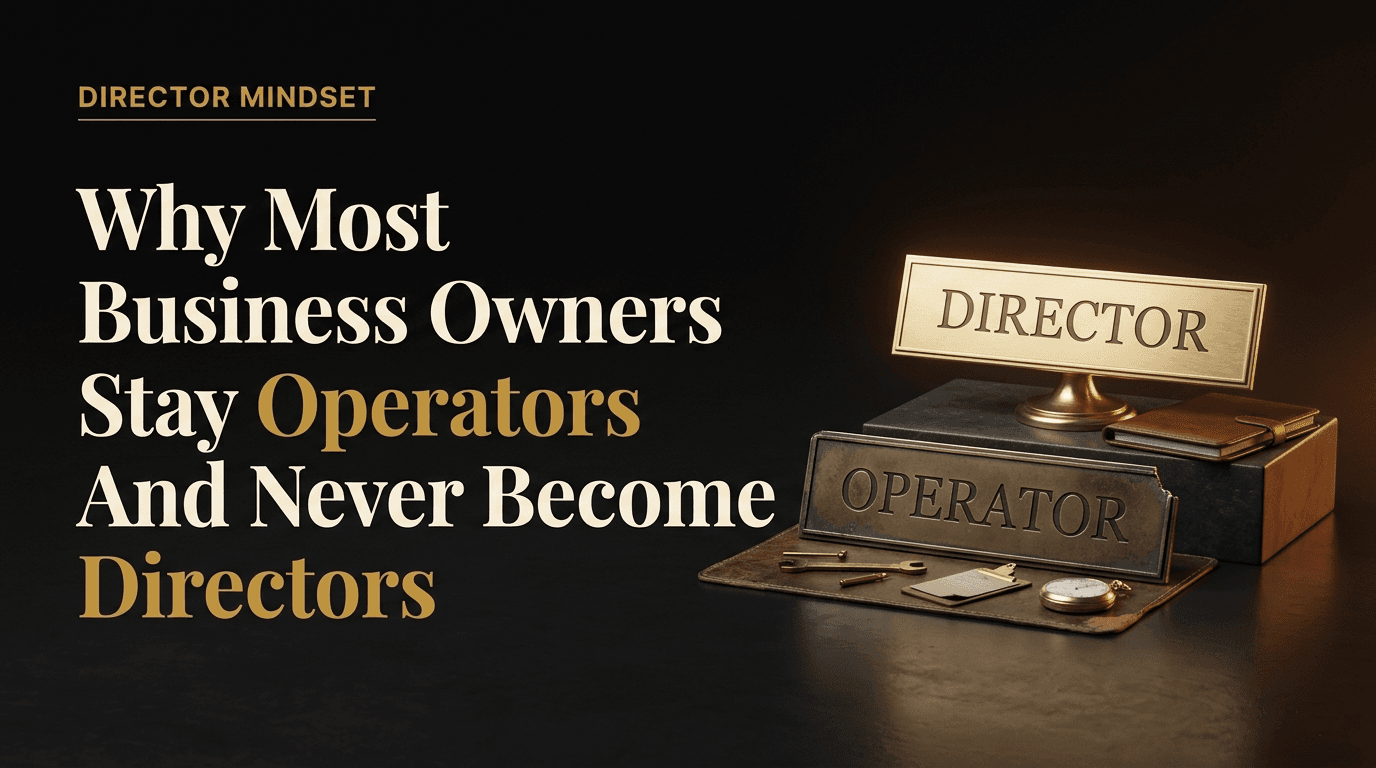
Why Most Business Owners Stay Operators (And Never Become Directors)
Many business owners remain deeply involved in daily operations and never transition into true director-level leadership. This article explains why the operator trap persists in established businesses and outlines the governance, structure, and decision systems required to move from operational management to director-level control.
Why Most Business Owners Stay Operators (And Never Become Directors)
Introduction
Many established businesses appear successful from the outside while internally remaining heavily dependent on the owner.
The business may have staff, revenue, systems, and clients, yet the owner still sits at the centre of operational decision-making.
They approve everything.
They solve problems daily.
They remain the escalation point for every operational issue.
This is the operator trap.
The business grows, but leadership structure does not evolve.
Instead of transitioning into a director role focused on governance, strategy, and control systems, the owner remains embedded in operational management.
The result is a business that scales in activity but not in leadership maturity.
The organisation becomes operationally fragile because too much authority, decision-making, and institutional knowledge sits with one individual.
Directorship requires a different operating model.
It requires governance systems, decision frameworks, and leadership accountability structures that remove the owner from daily operational dependency.
Most business owners never make this transition.
Quick Answer
Most business owners remain operators because their businesses are structured around their personal involvement rather than governance systems. Without formal decision frameworks, operational leadership layers, and reporting structures, the owner becomes the central problem solver. Directors build systems that run the organisation without daily intervention, whereas operators remain embedded in execution.
The Operator Trap in Established Businesses
In the early stages of a business, the founder must operate directly.
They sell.
They deliver.
They hire.
They solve operational problems.
This behaviour is necessary during the survival phase of a business.
However, many organisations continue operating this way long after they have staff, departments, and operational complexity.
Instead of evolving into structured leadership, the business becomes operator-led indefinitely.
Common indicators include:
The owner approves most decisions
Staff escalate problems directly to the owner
Operational bottlenecks occur when the owner is unavailable
Strategic work is repeatedly postponed due to operational demands
The business lacks clear leadership tiers
The owner becomes both the engine and the safety net of the organisation.
While this may feel like control, it actually introduces structural risk.
The business becomes dependent on the constant availability of the owner.
The Structural Difference Between an Operator and a Director
The difference between an operator and a director is not work ethic or intelligence.
It is role design.
Operators focus on execution.
Their daily responsibilities revolve around solving operational problems and ensuring the organisation functions.
Directors focus on governance, strategic direction, and organisational control systems.
Their responsibilities include:
defining organisational structure
setting operational accountability
monitoring performance through reporting systems
managing risk exposure
approving major strategic decisions
Operators ask:
What needs to be done today?
Directors ask:
What systems ensure the organisation performs without intervention?
When businesses fail to formalise this distinction, the owner naturally defaults to the role they understand best: operator.
This keeps them trapped in operational cycles.
Why Operational Success Prevents Leadership Evolution
Ironically, operational success often delays the transition to directorship.
When a business grows through the owner's direct involvement, it reinforces the belief that personal intervention is the reason the business works.
The owner becomes the highest performer in the organisation.
They close deals.
They resolve conflicts.
They fix operational problems quickly.
However, this creates two hidden consequences.
First, staff become conditioned to rely on the owner for solutions.
Second, systems never mature because the owner substitutes for them.
Operational strength begins to replace structural leadership design.
This pattern can continue for years until the business reaches a point where operational complexity exceeds what one person can control.
At that stage, leadership strain becomes visible.
The Hidden Risk of Operator-Led Businesses
Operator-led businesses carry significant risk that is often ignored.
When decision authority sits with the owner, the organisation becomes vulnerable in several ways.
Operational Risk
The business slows or stops when the owner is unavailable.
Leadership Risk
There are no empowered managers capable of independent decision-making.
Strategic Risk
Long-term planning is continuously interrupted by daily operational demands.
Governance Risk
The business lacks documented decision processes and oversight structures.
These risks are not always visible during periods of growth.
However, they become highly exposed when:
the business expands
operational complexity increases
regulatory oversight grows
leadership transitions become necessary
Without governance structures, the organisation remains person-dependent rather than system-dependent.
The Missing Layer: Governance Systems
The transition from operator to director begins with governance systems.
Governance is often misunderstood as corporate formality, but its real purpose is control and accountability.
Governance systems define:
who makes decisions
how decisions are documented
what reporting is required
how performance is monitored
how risk is managed
In an operator-led business, decisions are often informal.
The owner decides based on experience and immediate context.
In a director-led business, decisions follow structured processes.
This includes documented approvals, reporting frameworks, and operational accountability layers.
Governance allows the business to function without requiring the owner's constant presence.
Owners wanting to understand their governance maturity can evaluate their leadership structure using the [Established Business Assessment].
Leadership Accountability Structures
A critical step in becoming a director is creating leadership layers that carry operational responsibility.
Many business owners hesitate to delegate authority because they fear losing control.
In reality, directors increase control by formalising accountability.
Leadership accountability structures include:
defined departmental ownership
operational decision authority
reporting responsibilities
performance metrics
Managers must have both authority and accountability.
Without authority, managers cannot make decisions.
Without accountability, decisions lack ownership.
When leadership layers are properly structured, the owner no longer functions as the default operational decision-maker.
Instead, the owner oversees performance through reporting systems.
Decision Frameworks That Remove Operational Dependence
Directors avoid operational dependence by implementing decision frameworks.
Decision frameworks establish:
which decisions belong at each leadership level
when escalation is required
how risks are evaluated
how decisions are documented
Without decision frameworks, teams escalate routine issues to the owner.
This reinforces the operator role.
When decision frameworks are implemented, operational decisions are resolved at the appropriate level.
The director only becomes involved in strategic or high-risk decisions.
This shift dramatically reduces operational noise and allows leadership to focus on governance and long-term direction.
Organisations that lack structured decision processes often discover leadership bottlenecks during growth phases.
Cultural Resistance to Director-Level Leadership
Transitioning from operator to director often faces internal resistance.
Staff may initially prefer the operator model because the owner solves problems quickly.
Managers may avoid decision responsibility because escalation feels safer.
Over time, this creates a culture where authority flows upward rather than outward.
Directors must deliberately reshape this culture by:
enforcing decision ownership
refusing unnecessary escalations
requiring reporting rather than verbal updates
defining leadership boundaries
Leadership culture changes only when systems reinforce accountability.
Without structural changes, behavioural patterns will revert to the operator model.
Director Framework for Transitioning Out of Operations
Business owners who want to move into director-level leadership must implement structural changes.
The following framework provides a starting point.
Operational Authority Mapping
Define which operational decisions belong to each leadership role.
Reporting Infrastructure
Implement structured reporting that allows performance monitoring without operational involvement.
Governance Documentation
Create formal processes for approvals, strategic decisions, and risk evaluation.
Leadership Accountability
Assign operational ownership to managers with measurable performance outcomes.
Escalation Boundaries
Limit which issues reach the director level.
These systems gradually remove the owner from operational dependency.
Owners evaluating their leadership structure may also benefit from reviewing their current leadership role through the mrdirector.com.au/#single-director-business-assessment.
Director Actions This Week
Directors can begin transitioning out of operational leadership by implementing the following actions.
List the operational decisions currently requiring the owner's approval.
Identify which decisions could be reassigned to department leaders.
Document operational responsibilities across the leadership team.
Introduce weekly operational reporting from managers.
Establish clear escalation boundaries for leadership decisions.
Directors looking to formalise governance structures and operational leadership frameworks can review the systems outlined in the mrdirector.com.au/#download-playbook.
FAQs
What is the difference between a business operator and a director?
An operator manages daily execution within the business. A director oversees governance, strategy, and organisational performance through leadership systems and reporting structures.
Why do most business owners remain operators?
Many businesses are structured around the owner's personal involvement rather than leadership systems, which keeps the owner embedded in daily operational decisions.
When should a business owner transition into a director role?
The transition becomes necessary when the business develops staff, operational complexity, and strategic growth objectives that require governance and leadership oversight.
Can a single-owner business operate with director-level governance?
Yes. Even single-director organisations benefit from structured decision frameworks, reporting systems, and operational accountability structures.
What is the biggest barrier to becoming a director?
The biggest barrier is structural. Without governance systems and leadership accountability layers, the owner becomes the default operational problem solver.