
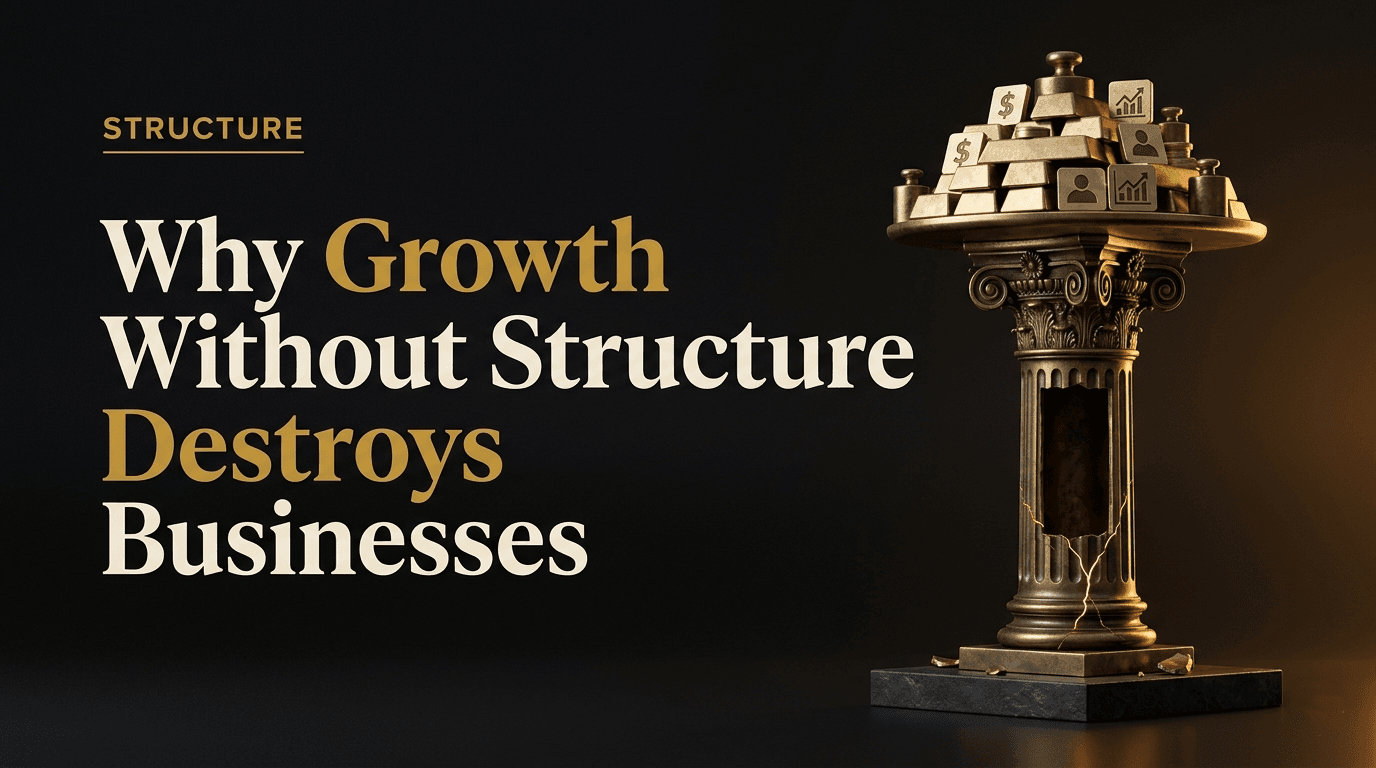
Why Growth Without Structure Destroys Businesses
Many businesses pursue aggressive growth before building operational structure. This creates leadership bottlenecks, operational chaos, and financial exposure. This article explains why growth without governance systems, leadership accountability, and operational processes destabilises businesses and outlines the director frameworks required to support sustainable expansion.
Why Growth Without Structure Destroys Businesses
A business chased a 40% revenue increase and spent the next year unwinding the operational damage it caused. That is not an edge case. Unstructured growth does not just create pressure. It amplifies every structural weakness already inside the business until something breaks. Directors understand this distinction and build the internal architecture before the growth arrives, not after it has already done the damage.
Quick Answer
Growth without structure destabilises businesses because operational complexity increases faster than governance, leadership systems, and processes can support. Without decision frameworks, reporting systems, and accountability structures, organisations accumulate financial exposure, experience delivery failures, and watch leadership burn out while the founder becomes the only thing holding the business together. Directors build structure before pursuing aggressive expansion, not after it has broken something.
The 7 Things Directors Need to Know About Growth Without Structure
Growth reveals structural weaknesses that were already there — it does not create them
Informal systems that survived small scale collapse quickly at volume
Decision bottlenecks during growth are an authority problem, not a workload problem
Leadership capacity becomes the hard ceiling on organisational throughput if structures do not evolve
Undocumented processes are not a gap during growth. They are a delivery risk that compounds with every new hire
Financial exposure during unstructured growth is where businesses actually die, not just struggle
Governance during growth is not compliance. It is the mechanism that keeps expansion from becoming exposure
Growth Amplifies Organisational Weakness
Every business contains operational weaknesses. During early stages they often remain invisible because small teams compensate through direct communication and improvisation. The founder solves problems quickly. Employees coordinate informally. The gaps stay hidden because volume is low enough that nobody falls into them.
Growth changes that. The informal handoff process that worked fine with eight people becomes the source of three client complaints a month with twenty-five. The undocumented pricing exception process the founder handled personally becomes a source of margin leakage when four different salespeople are making pricing calls from memory. Growth did not create those problems. It revealed them, accelerated them, and made them impossible to ignore simultaneously.
This condition is not caused by excessive ambition. It is caused by growth that outpaces structure.
Without structural improvements at each growth stage, every subsequent stage introduces greater instability than the last. The weaknesses compound rather than resolve.
That compounding hits informal systems first and hardest.
Informal Systems Collapse Under Scale
Early-stage organisations operate with informal systems because informal systems work when teams are small and communication pathways are simple. Tasks move through conversations. Responsibilities evolve organically. Processes remain undocumented because everyone already knows how things work.
As the business grows, that shared knowledge stops travelling. Multiple teams perform similar tasks in different ways. Employees develop inconsistent approaches to operational problems because no written standard exists to align them. Quality control becomes difficult to maintain because the standard was never documented, only understood by the people who were there when it developed.
When processes are standardised, the twelfth hire performs the same as the second because the process exists independently of the person. Without that documentation, every new hire inherits nothing and invents their own version. During growth that is not a minor inconsistency. It is a delivery risk that multiplies with every addition to the headcount.
Informal systems collapse at scale because they were never designed to operate beyond the founder's direct line of sight. Decision systems collapse for the same reason and faster.
Decision Bottlenecks Slow Organisational Momentum
Another consequence of growth without structure is the emergence of decision bottlenecks that look like workload problems and are almost always authority problems. In founder-led organisations, major decisions remain centralised by habit rather than design. Staff escalate upward for approval. Managers defer to leadership rather than taking responsibility because authority boundaries were never defined.
As activity increases, this pattern becomes unsustainable at a rate that surprises most founders. The number of decisions expands dramatically. Leadership attention fragments across operational issues that should sit two levels lower in the organisation. Routine decisions queue for approval while operational momentum stalls.
Director Rule: A decision that should take twenty minutes takes two weeks when it has to pass through the founder. Multiply that by fifty decisions a month and you have your growth problem.
Directors prevent this by implementing decision authority frameworks that distribute responsibility across leadership levels before the volume arrives. Defining who decides is not bureaucracy. It is what allows the organisation to keep moving when growth increases the decision load.
When decision systems break, leadership capacity becomes the next constraint.
Leadership Capacity Becomes the Limiting Factor
Growth introduces pressure on leadership capacity that most founders underestimate until they are already inside it. In smaller businesses, the founder manages operations directly, oversees teams, resolves client issues, and makes strategic decisions simultaneously. That model works until it does not, and the point at which it stops working arrives faster during growth than at any other stage.
As the organisation expands, employees increase, operational problems multiply, and client expectations become more complex. If leadership structures do not evolve alongside that expansion, the founder becomes the organisation's primary constraint. Managers rely on the founder to resolve problems that should stay within their function. Progress slows whenever the founder is unavailable, which during a growth phase is precisely the moment the organisation can least afford it.
Directors establish leadership layers with defined operational ownership so the founder gets their attention back for the decisions that actually require director-level thinking. During a growth phase, that recovered attention is what allows strategy to keep pace with operational expansion.
When leadership capacity is constrained, the operational processes underneath it deteriorate at the same time.
Undocumented Processes Were Never There to Begin With
The standard narrative about operational processes during growth is that they break down under volume. That framing misses the real problem. Processes that were never documented do not break during growth. They were never there to begin with. Growth simply makes their absence visible and consequential.
Every new hire who joins a business without documented processes inherits nothing. They watch how things are done, form their own interpretation, and execute accordingly. At ten people the variation is manageable. At thirty it produces inconsistent service delivery, client experience that varies by team member, and errors that are expensive to trace because nobody can point to a standard that was violated. There was no standard. There was a habit, shared by the original team, that did not transfer.
Directors stabilise operations by implementing repeatable workflows and documented procedures before growth makes their absence a delivery risk. Operational systems ensure that tasks move through the organisation consistently regardless of which employee performs them, which is the only definition of operational capability that actually scales.
Director Rule: Undocumented process is not flexibility. It is operational risk that becomes a delivery failure the moment volume exceeds what the original team can personally supervise.
Financial risk during growth compounds at the same rate as operational risk and with less visibility.
Financial Risk Expands Without Visibility
Financial risk during growth is not theoretical. It is the gap between what the revenue line shows and what the cost structure actually demands, and it widens fast when nobody is measuring it.
The business that hired twelve people in nine months to service new client demand, hit a slow quarter, and discovered its fixed cost base was now twice what its revenue could support was not unlucky. It was operating without financial visibility during a growth phase. The cost commitments made during expansion were not stress-tested against downside scenarios because the reporting systems to do that stress-testing did not exist. By the time the exposure became visible, the options for managing it had narrowed significantly.
Financial risk during growth is not theoretical. It is the gap between what the revenue line shows and what the cost structure actually demands, and it widens fast when nobody is measuring it:
Cost structures by department revealing where payroll and operational spending are growing relative to output
Departmental spending against budget so growth investment decisions are made against actual numbers rather than assumptions
Operational efficiency showing whether the business is getting more or less capable per dollar of cost as it grows
Cash flow exposure across the forward period so hiring and investment decisions account for what a slow month looks like
Profitability trends by client and service line so the revenue that looks like growth can be tested against whether it is actually profitable
Financial reporting allows leadership to make informed decisions about growth strategies rather than committing the business to cost structures it may not be able to sustain. Without this visibility, organisations expand faster than their financial infrastructure can support and discover the problem at the worst possible moment.
Governance is what prevents financial exposure from becoming the organisation's default operating condition during growth.
Without Governance, Growth Is Just Accelerated Exposure
Governance during growth is not a compliance exercise. It is the mechanism that stops fast decisions from becoming expensive mistakes. Without governance, decisions are made through informal discussions at exactly the stage when those decisions are carrying the most financial and operational consequence.
During rapid expansion, governance is the difference between a director who knows what is happening across the organisation and one who finds out about problems after they have already cost the business. That is not a marginal improvement. At growth stage, it is the difference between expanding with control and expanding into exposure.
The governance components that protect organisations during growth:
Defined decision authority so decisions are made at the right level rather than escalating to whoever has bandwidth
Approval pathways for strategic initiatives so commitments are reviewed before the organisation is bound to them
Performance reporting systems that surface emerging risks before they become operational crises
Leadership accountability structures that assign ownership of growth outcomes to specific roles
Businesses that want to evaluate whether their governance structures support sustainable growth can review their leadership systems through mrdirector.com.au/#established-business-assessment.
Director Rule: Governance is not what you build after you have grown. It is what makes growth survivable while it is happening.
Even with governance in place, founder dependency during growth can undermine every other system the organisation has built.
Founder Dependency Intensifies During Growth
Many growing businesses remain heavily dependent on the founder at exactly the stage when that dependency is most dangerous. As staff numbers increase, operational complexity multiplies and more issues require attention simultaneously. The volume of decisions reaching the founder grows faster than their capacity to process them.
The result is delays, frustration within teams that cannot get answers fast enough to maintain momentum, and strategic stagnation as the founder spends all available attention on operational decisions rather than the growth strategy that created the volume in the first place.
Directors reduce founder dependency by implementing governance systems and leadership structures that distribute authority across the organisation before growth makes the single-point dependency critical. Founders evaluating their current leadership role may benefit from reviewing mrdirector.com.au/#single-director-business-assessment.
These five systems are what convert that structural change from intention into operational reality.
The 5 Systems That Make Growth Sustainable
These systems do not slow growth. They are what prevents growth from breaking the organisation that is generating it. The objection that structure creates bureaucracy confuses governance with administration. Structure is what allows the business to move faster during growth because decisions have clear owners, processes have documented standards, and leadership has visibility into what is happening without personally supervising every function.
Operational System Development: Establish documented workflows that standardise execution across departments before growth volume makes their absence a delivery risk. When the process exists independently of the people who built it, growth adds capacity without adding chaos.
Leadership Accountability Structures: Assign clear operational ownership across leadership roles with defined authority boundaries and outcome metrics. Growth multiplies the number of decisions the organisation must make. Leadership accountability structures ensure those decisions are made at the right level rather than accumulating at the founder's desk.
Decision Authority Frameworks: Define which decisions belong at each leadership level and document the escalation threshold for each category. During growth, decision velocity matters. Authority frameworks are what maintain that velocity when volume increases.
Financial Reporting Infrastructure: Implement reporting systems that provide visibility into cost structures, operational efficiency, and cash flow exposure on a structured schedule. Financial reporting is what allows directors to commit to growth investment with confidence rather than operating on assumptions that the revenue line will support whatever the cost line requires.
Governance Systems: Establish oversight mechanisms that monitor strategic initiatives and risk exposure during expansion. Governance during growth is not optional. It is the structure that ensures each growth stage strengthens the organisation rather than exposing the weaknesses the previous stage left behind.
Directors seeking structured templates for implementing these frameworks can access them at mrdirector.com.au/#download-playbook.
Director Actions This Week
Identify the operational areas currently running without documented processes and prioritise the three where inconsistency is creating the most visible delivery or quality risk
Map decision authority across leadership roles in writing so managers know what they can approve without escalation before the next growth phase increases decision volume
Introduce structured reporting for operational and financial performance in at least one function that currently has no systematic visibility
Evaluate whether leadership roles have clear accountability boundaries with defined outcome metrics or whether accountability is currently assumed rather than assigned
Review governance procedures for strategic decisions and document the approval standard for any major commitment that does not currently have a formal review process
FAQs
Why can rapid growth harm a business? Rapid growth increases operational complexity faster than most organisations can adapt their internal systems to handle it. Without governance, documented processes, and leadership accountability, the organisation accumulates delivery failures, financial exposure, and founder dependency simultaneously. Growth does not cause these problems. It accelerates the structural weaknesses that were already present.
What type of structure do growing businesses need? Leadership accountability systems, operational workflows, governance frameworks, and financial reporting structures. These four elements work together. Operational workflows create consistency. Leadership accountability ensures they are followed. Governance protects strategic decisions. Financial reporting maintains visibility. A business that has one or two of these but not all four will find the missing elements under pressure during growth.
Is founder involvement a problem during growth? Concentrated founder dependency is a problem during growth because it creates a single-point bottleneck at exactly the stage when decision volume is highest. Founder involvement in strategic oversight and governance is appropriate and necessary. Founder involvement in routine operational approvals is a structural problem that compounds as the organisation grows.
When should governance systems be introduced? Before growth makes their absence visible. The business that implements governance frameworks during a growth phase is significantly better positioned than the one that installs them after a growth phase has exposed the gaps. The cost of reactive governance is always higher than the cost of proactive governance.
What is the first step toward structured growth? Implement operational systems and leadership accountability so the organisation can manage increased activity without relying on informal coordination or founder intervention. Until those two elements exist, every other structural improvement is limited by the same underlying dependency.
How fast is too fast to grow without structure in place? Any growth rate that outpaces the organisation's ability to maintain consistent delivery quality, make decisions at appropriate speed, and maintain financial visibility is too fast. The signal is not a revenue number. It is when operational errors increase, decision queues grow, and the founder's involvement in daily operations expands rather than contracts during a growth phase.
Can you build structure while growing, or does growth need to pause first? Growth does not need to pause. Structure and growth can be built simultaneously, and in most cases they must be. The practical approach is to implement the highest-priority systems, typically decision authority and documented processes, during the growth phase rather than before or after it. Waiting for growth to slow before building structure usually means building it after the damage is already visible.
If you have been growing and can feel the structure failing to keep up, apply to work with Benjamin Collins directly before the next growth phase breaks something harder to fix.
Benjamin Collins has sat across 17 director tables since 2014. He knows what this looks like from the inside.