
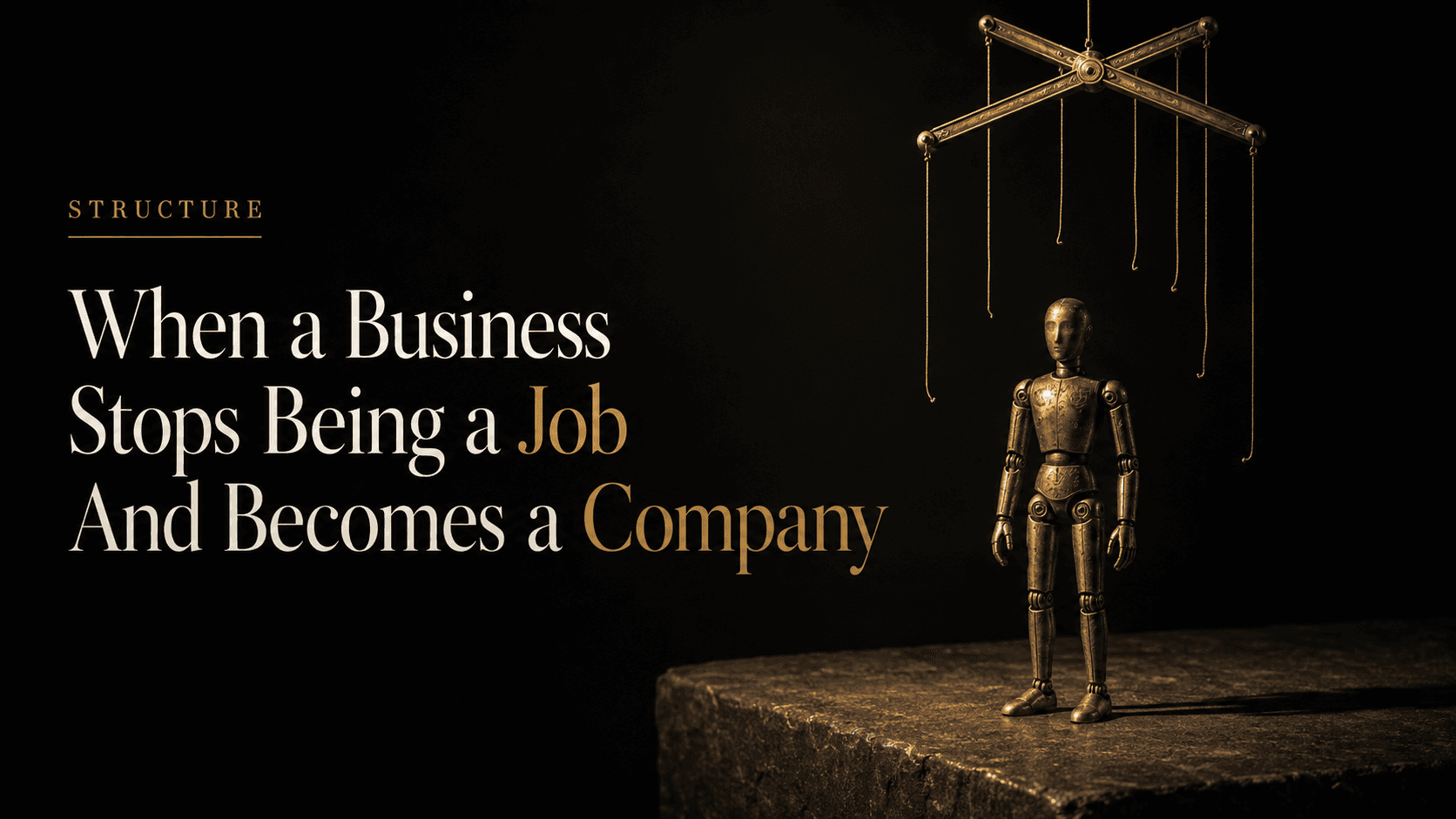
The Moment a Business Stops Being a Job and Starts Being a Company
Legally, most businesses incorporate within a year. Operationally, most never complete the transition. Here's what it actually takes for a business to stop depending on its founder and start functioning as a company with independent value.
The Moment a Business Stops Being a Job and Starts Being a Company
There's a specific feeling most business owners recognise but rarely name: the business turns over decent money, but every morning it starts again from zero, and if you stopped, it would stop. The revenue is real. The business, as a transferable asset independent of its founder, doesn't exist yet.
Quick Answer: When Does a Business Stop Being a Job and Start Being a Company?
A business becomes a company operationally, not just legally, when it can generate revenue and sustain its obligations without the founder's daily involvement. That requires documented systems, a team empowered to make decisions, an independent financial structure, and a director governing from above rather than operating inside it, a transition most businesses never complete.
The 6 Signs Your Business Is Still a Job
Before the framework, here's the diagnostic. If four or more of these describe your business, the transition hasn't happened yet.
You are personally the primary revenue generator and no system exists to replace that function.
The business cannot operate for three weeks without you making at least daily contact.
Your team escalates most decisions to you because they don't have the authority, information, or process to resolve them independently.
Your pricing hasn't been reviewed at a governance level because nobody has that role except you, and you haven't done it.
The business's financial management exists primarily in your head and your accountant's annual return.
If you were to list the business for sale today, the first question a buyer would ask is whether you're staying on.
That last one is the clearest signal. A job with employees is still a job. A company is an asset that operates independently of any individual, including its founder.
The Legal Company vs the Operational Company
This distinction is where most business owners get confused. They incorporated early, they have an ACN and a director title on the ASIC register, and they call it a company.
Legally it is. Operationally it isn't. Legal incorporation creates a separate entity, but operational independence is what makes that entity valuable, and the gap between the two is where most established businesses sit.
An acquirer, a bank, or an investor looks past the legal structure and assesses the operational one. Does this business have documented processes? Does the team function without the founder's daily presence? Is the revenue attached to the business or to the individual running it? Those questions determine the value and the risk, not the ABN or ACN.
Director Rule: Incorporation is a legal decision made in an afternoon, while operational independence is a governance project that takes years, and most businesses have completed the former and barely started the latter.
What the Transition Actually Requires
The shift from job to company is not a mindset change. It's a structural change with four specific components.
1. Documented Systems That Exist Outside Any Individual's Head
The first question to ask: if your two most experienced team members left tomorrow, how much of what they know would leave with them?
In most established businesses, the answer is most of it. The processes exist in their heads, in their email inboxes, and in institutional memory that's never been written down, so when they leave, the business loses function and the replacement has to reconstruct everything from first principles.
That's a systems problem, not a people problem. The fix is documentation to a level of specificity that a competent person can follow without asking questions, capturing how the work gets done, what good output looks like, and who owns each step.
Director Rule: A process that lives in someone's head is a personal dependency, not a business asset, and the transition to company requires converting those dependencies into documented systems, one process at a time.
2. A Team Empowered to Make Decisions Without the Director
The signal that a business is still a job is the volume of decisions that escalate to the director, not because the team is incapable, but because they don't have the authority, information, or process to make those decisions independently. If you're a solo director with no team to empower yet, you're carrying that entire escalation load personally by default, and the Single Director Business Assessment will show you exactly where that's costing you.
The fix is governance design, not personnel change. Three things enable team-level decision-making: authority, explicit thresholds for who can decide what without asking; information, access to the financial, client, and operational data needed to make good calls; and process, a documented path for how each type of decision gets made.
When these three elements exist, the director stops being the decision bottleneck, and decisions happen at the right level.
3. A Financial Structure That Isn't the Director's Memory
Most owner-operated businesses at the job stage have a financial structure that consists of the director checking the bank account, the accountant doing the BAS, and a vague sense of how things are tracking. That's financial improvisation, not a financial structure.
A company-level financial structure includes a weekly financial review cadence, rolling twelve-week cash flow forecasting, tax reserves separated from operating capital in real time, and reporting the director reviews rather than produces. When it exists independently of the director's memory, the business can be reviewed and understood by anyone with access to the reporting.
Director Rule: If your business's financial management requires your personal involvement to function, it's a personal obligation attached to the business, not a financial structure, so build the structure first and govern it rather than run it.
4. A Director Who Governs From Above Rather Than Operates From Inside
This is the hardest shift, not because the director lacks capability, but because operating inside the business is familiar and validating while governance feels abstract by comparison.
The transition requires the director to deliberately step back from operational involvement and take up a position above the business rather than inside it: setting direction rather than executing it, reviewing performance rather than managing it, and governing risk rather than responding to it. That's the same shift that shows up at scale in multi-person governance structures, which is exactly what the Established Business Assessment maps.
It also means tolerating a period where things are done differently than the director would do them personally, and resisting the instinct to step back in and fix it. The business will keep needing you if you keep responding to the need.
Director Rule: The moment you stop being the answer to every question is the moment the business starts becoming a company, and that shift is deliberate, not accidental.
What the Business Looks Like on the Other Side
This is worth making concrete, because the transition requires sustained effort and the return needs to be visible.
A business that has completed the operational transition has revenue generated by a team following documented processes, not the director's personal relationships alone. The director can take three weeks away without daily contact and return to an operation that has continued functioning. Decisions are made at the appropriate level, the financial structure runs on a governance cadence, and the business has value independent of its founder's continued involvement.
That's a company. It generates enterprise value and can be grown, scaled, financed, or sold. The job, by contrast, generates income for its operator, cannot be sold at a meaningful multiple without the founder, and has no value independent of the person running it. Both can generate the same revenue. The company is worth materially more.
The Transition Isn't a Single Event
This is the expectation that creates the most frustration. Business owners look for the moment the transition happens. There isn't one. It's a project.
The documentation gets built incrementally, one process at a time, starting with the highest-impact gaps. The team's decision-making authority is extended gradually and tested as confidence builds.
The financial structure is designed and refined through a few reporting cycles before it runs cleanly, and the director's step-back happens in stages, not all at once. The typical timeline from deliberate commencement to a business operating at company level is 18 to 36 months, and it feels long only because the business is demanding your daily presence while you build the structure that will replace that demand.
Director Actions This Week
The transition starts with a clear-eyed picture of where the business is now.
Run the diagnostic above. Count how many of the six signs apply to your business today, since that number tells you where the transition is.
Identify the single highest-impact process that exists only in your head or a team member's head. Document it this week, to the level that a competent person could follow it without asking questions.
List the decisions that escalated to you last week that shouldn't have. For each one, identify whether the fix is authority, information, or process, and build one this week for the most common escalation type.
Check whether your business could operate for three weeks without your daily involvement. If not, identify the single point of failure that would cause the collapse.
Download the Director Playbook for the full transition framework, including the systems documentation template and the decision authority matrix.
FAQ: When a Business Becomes a Company
What is the difference between a business that's a job and one that's a company?
A business that's a job generates income for its operator and depends on that operator's daily presence, so if the operator stops, the business stops. A business that's a company generates value independently of any individual, with documented systems, an empowered team, and a director governing from above rather than operating from inside. Both can generate the same revenue, but the company is worth materially more.
How long does the transition from job to company take?
For most established businesses starting deliberately, 18 to 36 months is a realistic timeframe. The documentation gets built incrementally, the team's decision authority is extended gradually, and the director's step-back happens in stages rather than as a single event.
What is the most common obstacle to making this transition?
The director's instinct to step back in when things go wrong. The transition requires tolerating a period where things are done differently than the director would do them personally, and every time the director steps back in to fix something the structure should be handling, they delay the transition.
Does this mean I have to stop working in my business?
Not entirely. At $1M+ revenue, some director-level operational involvement, key client relationships, and commercial decisions all benefit from director presence. The transition is about the director's presence sitting at the governance level rather than the delivery level, not about the director having no role at all.
What makes a business more valuable: revenue or systems?
Systems. Two businesses generating the same revenue are valued very differently based on whether that revenue depends on the founder, and enterprise value rewards the operational independence that systems create.
How do I know if I've completed the transition?
The test is absence: can the business operate for three weeks without your daily involvement and return to full function? A secondary test is whether a buyer would pay for the business today without assuming you stay on.
What is the financial impact of completing the transition?
Material. A business that operates independently of its founder commands a higher enterprise value multiple, typically 1 to 2 turns of EBITDA higher for businesses where owner dependency has been demonstrably reduced. At $400,000 in EBITDA, that's $400,000 to $800,000 in additional enterprise value created by the structural transition alone, without any revenue or margin improvement.
Ready to design the transition with Benjamin directly? Apply to become a client.
Benjamin Collins is a financial adviser and director with 17 directorships since 2014. He works with established Australian business owners to build the governance structures that convert owner-dependent jobs into company assets worth building, holding, and eventually selling.