
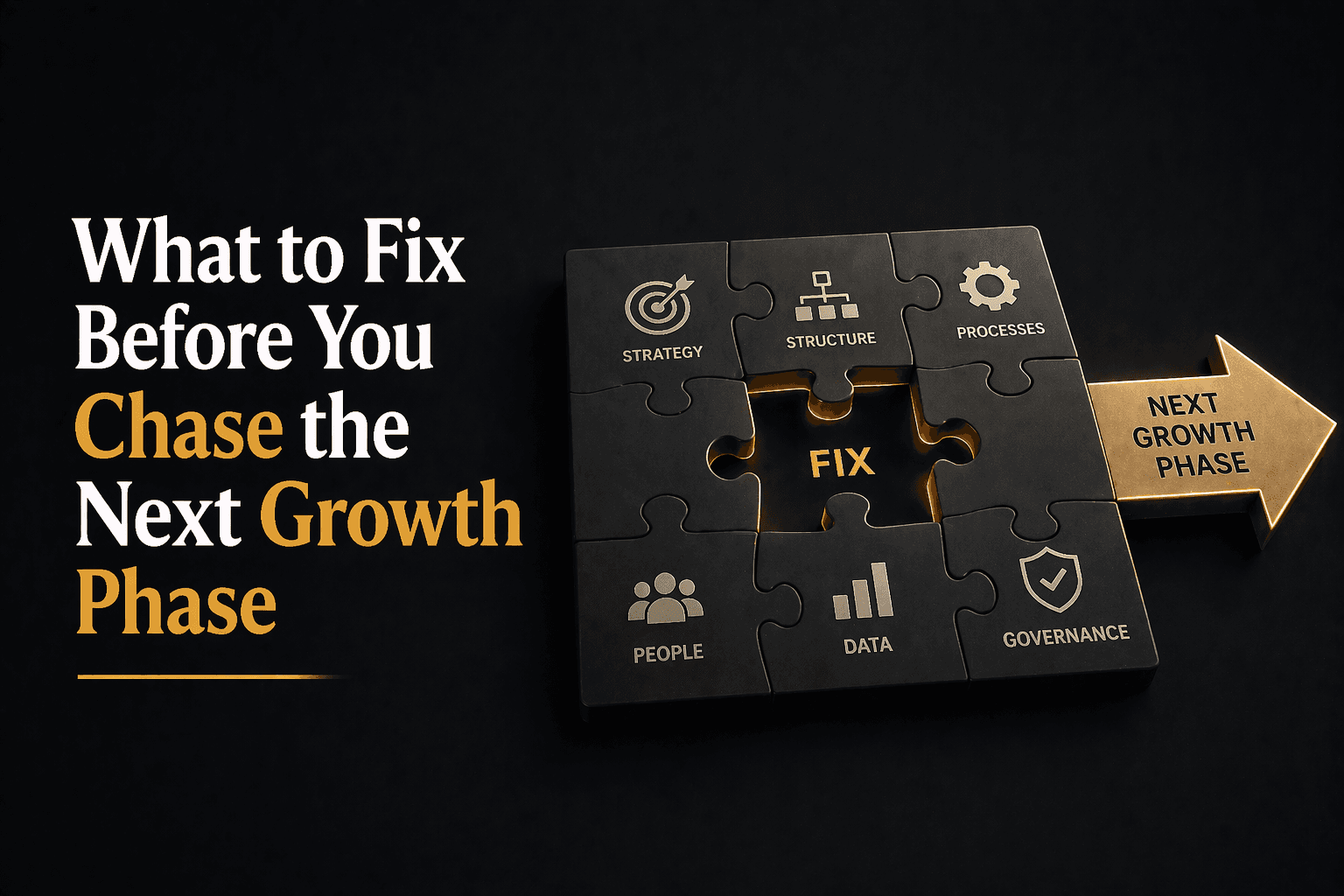
What to Fix Before You Chase the Next Growth Phase
Growth often exposes structural weaknesses inside established businesses. Before pursuing the next expansion phase, directors must stabilise cash visibility, decision rights, operational systems, and management accountability to prevent scale from amplifying risk and operational fragility.
What to Fix Before You Chase the Next Growth Phase
Growth is usually treated as the objective.
More clients. More revenue. More market share.
However, for established businesses, growth is not automatically progress. Expansion amplifies whatever structure already exists inside the organisation. If systems are disciplined, growth compounds strength. If systems are weak, growth compounds fragility.
Directors often pursue the next growth phase while unresolved structural issues remain beneath the surface.
Operational bottlenecks. Unclear decision authority. Limited financial visibility. Informal processes that worked at smaller scale.
These issues rarely stop the business immediately. Instead, they remain hidden while growth accelerates.
Eventually the organisation reaches a point where scale exposes every unresolved weakness at once.
The responsible director question is not how to grow faster.
The responsible question is what must be stabilised before scale increases pressure on the organisation.
Quick Answer
Before pursuing the next growth phase, directors must stabilise financial visibility, decision authority, operational systems, management accountability, and governance oversight. Growth multiplies existing weaknesses. If cash control, delegation structures, and reporting cadence are unclear, expansion will increase operational stress, compliance exposure, and leadership bottlenecks rather than strengthening the business.
Growth Magnifies Structural Weakness
When a business grows, complexity increases across multiple dimensions simultaneously.
More staff
More clients
More operational decisions
More compliance obligations
More financial commitments
What worked when the business was smaller often stops functioning under increased pressure.
An informal approval process becomes a bottleneck. A spreadsheet-based financial process becomes unreliable. A founder-led decision model slows throughput.
The organisation begins to rely on constant intervention from the director.
Growth does not create these weaknesses.
Growth reveals them.
Directors who ignore these signals often discover that the next stage of expansion creates operational instability rather than scale.
The Founder Bottleneck Must Be Removed
Many established businesses remain operationally dependent on the founder or director.
Key decisions still require their involvement:
Pricing exceptions
Hiring approvals
Client escalations
Supplier negotiations
Operational problem solving
Initially this concentration of control feels efficient.
However, as transaction volume increases, the director becomes the central constraint on decision speed.
Managers wait for approvals. Projects stall while leadership availability is confirmed. Escalations accumulate in the director’s inbox.
The organisation adapts by routing everything through one person.
This creates key-person dependency.
If your absence would materially disrupt operations, the structure is fragile.
Businesses experiencing this dependency should review structural exposure through the diagnostic in mrdirector.com.au/#single-director-business-assessment.
Cash Visibility Must Come Before Expansion
Revenue growth does not guarantee financial stability.
Many growing businesses experience cash pressure even while reporting profitability.
Growth increases:
Payroll obligations
Supplier commitments
Delivery costs
Working capital requirements
If directors do not maintain forward visibility across these commitments, cash strain can appear suddenly.
Common blind spots include:
Receivables concentration risk
Delayed invoicing cycles
Cost expansion linked to growth
Deferred tax obligations
Directors must operate with forward-looking financial visibility, not just retrospective reporting.
A rolling cash forecast and disciplined receivables monitoring are prerequisites for responsible expansion.
Without them, growth amplifies financial uncertainty.
Operational Systems Must Replace Memory
In early stages, businesses rely heavily on personal knowledge.
Processes live in the founder’s head. Staff learn by observing experienced employees. Quality standards are enforced through direct involvement.
This model collapses when scale increases.
Without documented systems, teams interpret tasks differently. Delivery standards vary. Managers intervene constantly to correct errors.
The result is operational inconsistency and rising workload.
Documented operating systems provide stability.
They define:
Delivery steps
Quality standards
Expected timelines
Escalation thresholds
Systems reduce ambiguity.
They allow staff to deliver consistently without requiring constant supervision.
Decision Rights Must Be Explicit
One of the most common scaling failures is unclear decision authority.
Managers hold titles but lack defined boundaries for decision making.
This causes operational paralysis.
Managers escalate routine issues because they fear making the wrong call. Directors become the final approval layer for decisions that should occur inside the organisation.
Decision rights must be documented across categories such as:
Commercial pricing limits
Hiring authority
Procurement thresholds
Contract variations
Client escalation protocols
When decision authority is clear, the organisation stops routing routine decisions through the director.
The director becomes an escalation point rather than an operational hub.
Management Accountability Must Be Real
Growth often leads businesses to hire managers.
However, management roles frequently lack genuine accountability.
Managers may supervise staff but do not fully own outcomes. When results fall short, the director intervenes to correct issues personally.
This prevents leadership capability from developing inside the organisation.
True management accountability requires:
Clear functional ownership
Defined outputs and targets
Decision authority within that function
Consequences when commitments are missed
Directors must resist the temptation to personally rescue delivery.
When directors absorb operational failures, they unintentionally prevent the organisation from developing competence.
Operating Cadence Must Replace Reactive Management
Businesses that operate reactively struggle to scale.
Directors and managers spend their time responding to issues rather than reviewing performance systematically.
An effective operating cadence creates predictable decision rhythms.
Typical cadence includes:
Weekly functional performance reviews
Weekly financial visibility across cash flow and pipeline
Monthly operational planning sessions
Monthly compliance reviews
Quarterly strategic alignment
This structure ensures that issues surface early.
Instead of discovering problems during crises, leadership reviews performance continuously.
For directors seeking a template for this cadence structure, the operational framework is outlined inside mrdirector.com.au/#download-playbook.
Compliance and Risk Exposure Increase With Scale
As businesses grow, regulatory exposure expands.
Additional employees introduce employment law obligations. Expanded service offerings may trigger licensing requirements. Increased data collection introduces privacy risk.
Compliance failures rarely appear immediately.
They become visible during disputes, audits, or regulatory investigation.
Directors must treat compliance as a structural system, not an administrative task.
Key areas requiring structured oversight include:
Payroll compliance
Employment documentation
Workplace health and safety
Data protection practices
Contract management
Growth increases the consequences of failure.
Directors must ensure the organisation can demonstrate compliance discipline, not merely assume it exists.
Governance Must Mature With the Organisation
As businesses scale, governance must evolve.
Early-stage organisations often operate with informal leadership discussions rather than structured board oversight.
However, increasing complexity requires disciplined governance practices.
These include:
Formal board agendas
Documented decisions and resolutions
Regular financial oversight
Strategic planning cycles
Risk register reviews
Governance is not bureaucracy.
It is the mechanism through which directors demonstrate diligence and maintain control as the organisation expands.
If directors are uncertain where governance gaps currently exist, the structural diagnostic inside mrdirector.com.au/#established-business-assesment provides a useful starting point.
Director Framework
Directors should stabilise the following systems before pursuing the next growth phase.
Financial Visibility System
Maintain rolling cash forecasts, receivables monitoring, and forward commitment visibility.Delegation and Decision Rights Framework
Define authority limits for commercial, operational, and financial decisions.Documented Operating Systems
Standardise delivery processes and quality expectations across the organisation.Management Accountability Structure
Assign functional ownership with measurable outputs and decision authority.Governance and Risk Oversight
Maintain structured board review cadence and formal risk register.
These systems allow growth to occur without destabilising operations.
Director Actions This Week
Identify operational decisions currently routed through the director
Document decision rights for pricing, hiring, and procurement
Review current 90-day cash flow visibility
Identify undocumented operational processes repeated weekly
Assign functional ownership for key operational areas
Implement a weekly management performance review cadence
Conduct a compliance status review with finance and HR
FAQs
Why should directors stabilise systems before pursuing growth?
Because growth amplifies existing weaknesses. If operational systems and financial visibility are weak, expansion increases instability rather than strengthening the organisation.
What is the most common structural problem before scaling?
Founder dependency. When too many decisions require director involvement, operational throughput slows and leadership capability inside the organisation cannot develop.
How does cash flow risk increase during growth?
Growth increases payroll, supplier commitments, and delivery costs. Without forward cash visibility, these obligations can exceed available liquidity.
Why do operational systems matter before expansion?
Documented systems ensure consistent delivery standards across teams. Without them, service quality varies as workload increases.
What is the director’s role during a growth phase?
The director’s role is to control systems, governance, and financial oversight. Operational execution should occur within a structured management layer.