
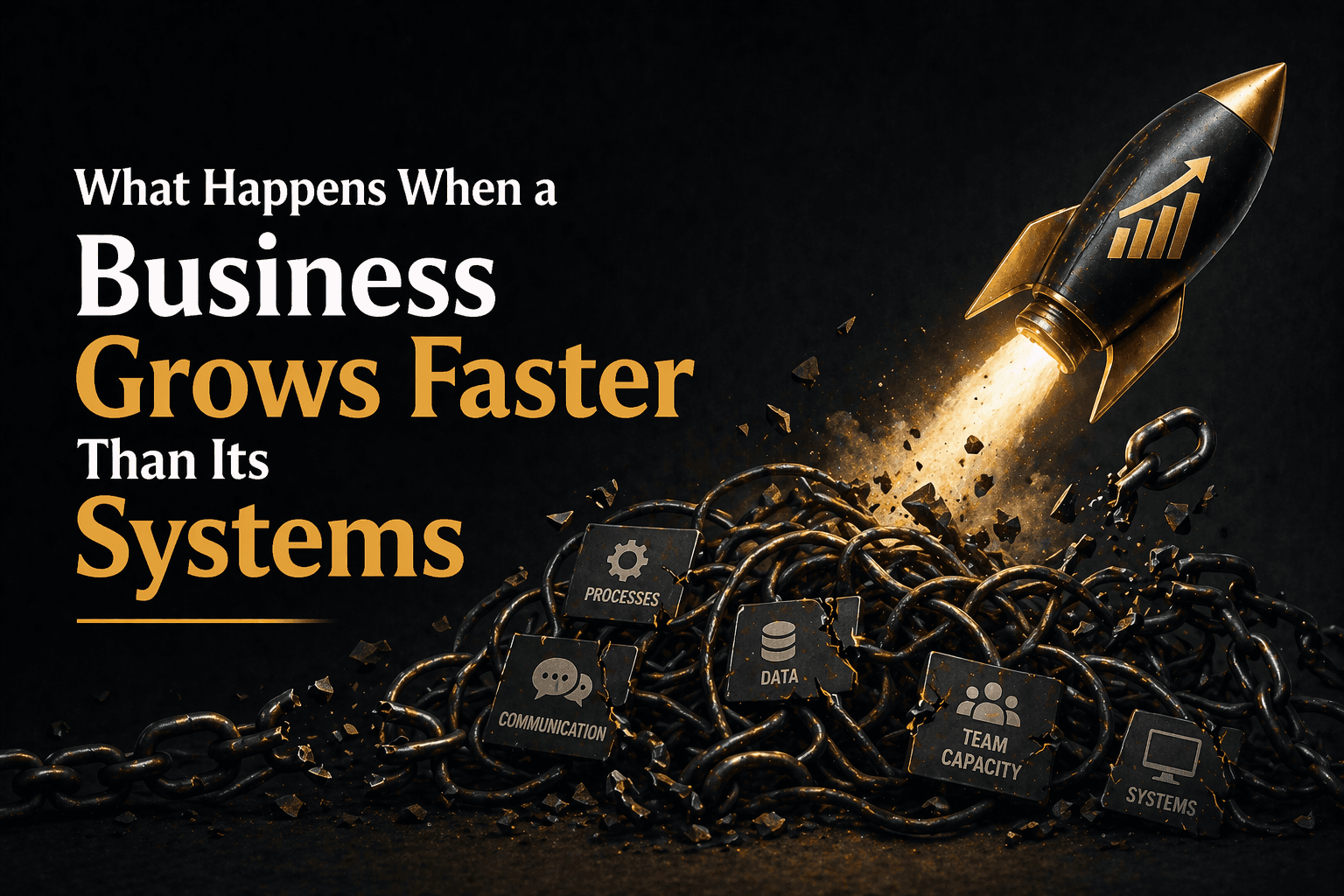
What Happens When a Business Grows Faster Than Its Systems
When a business grows faster than its systems, instability follows. Learn the structural risks of rapid growth and how to regain control before damage compounds.
Fast growth can destroy a business.
Revenue increases.
Demand increases.
Pressure increases.
If systems do not expand at the same pace, instability compounds.
Growth without structure creates stress fractures inside the organisation.
They do not appear immediately.
They appear when the pressure becomes unsustainable.
Director Rule:
Growth amplifies weakness.
Quick Answer
When a business grows faster than its systems:
Delivery quality declines
Margins compress
Cash flow becomes volatile
Staff burnout increases
Founder dependency intensifies
Reputation risk rises
Rapid growth without structural reinforcement increases fragility, not strength.
Scale must be supported by systems across revenue, operations, finance, and leadership.
The Structural Consequences of Outrunning Your Systems
There are predictable failure patterns when growth exceeds infrastructure.
They occur in sequence.
Phase 1: Operational Strain
At first, growth feels positive.
More sales.
More momentum.
More validation.
Behind the surface:
Onboarding becomes rushed
Handover mistakes increase
Staff skip process steps
Quality control weakens
Delivery becomes inconsistent.
Rework increases.
Margins begin to erode quietly.
Director Rule:
Operational strain is the first warning sign.
Phase 2: Margin Compression
As demand rises:
Discounts increase to close faster
Overtime increases to meet deadlines
Hiring decisions become reactive
Scope creep expands unnoticed
Revenue rises.
Profitability declines.
Without margin tracking systems, the decline remains hidden until cash tightens.
Director Rule:
Revenue growth without margin control is illusion.
Phase 3: Cash Flow Volatility
Rapid expansion increases:
Payroll commitments
Fixed overhead
Marketing spend
Working capital pressure
If forecasting systems are immature:
Cash gaps appear unexpectedly
Credit reliance increases
Decision-making becomes reactive
Growth begins to feel heavy instead of controlled.
Financial pressure accelerates operational stress.
Phase 4: Leadership Breakdown
As complexity increases:
The founder becomes central bottleneck
Staff escalate more decisions
Meetings increase but clarity decreases
Accountability becomes emotional
Founder fatigue increases.
Decision quality declines.
Strategic thinking disappears under operational noise.
Director Rule:
When leadership becomes reactive, systems are insufficient.
Phase 5: Reputational Risk
Inconsistent delivery produces:
Client complaints
Delays
Missed expectations
Increased churn
Reputation damage spreads faster than growth.
At this stage, recovery requires structural rebuild.
Why This Happens
Businesses often expand revenue before expanding structure.
Common causes:
Aggressive marketing without delivery control
Hiring before documenting processes
Ignoring financial forecasting
Founder reluctance to relinquish control
Overconfidence from early success
Growth feels urgent.
System development feels optional.
It is not.
Director Rule:
Infrastructure must scale before volume.
The System Lag Effect
System lag occurs when:
Demand increases faster than operational documentation
Headcount increases without role clarity
Sales increase without pricing discipline
Cash flow increases without forecasting
Lag creates instability because structure always trails growth.
The greater the lag, the greater the correction required.
Warning Signs You Are Outrunning Your Systems
Directors should assess the following indicators:
Increased rework or client complaints
Staff confusion about priorities
Founder working longer hours despite growth
Margin decline despite higher revenue
Cash surprises
Delayed internal reporting
Firefighting becoming normal
If three or more are present, system lag exists.
Director Rule:
Firefighting is structural evidence, not temporary inconvenience.
Practical Example: Rapidly Expanding Service Firm
Before Rapid Growth:
Moderate client base
Informal processes
Founder heavily involved
After Aggressive Expansion:
Client volume doubled
No onboarding structure
Hiring reactive
Cash forecast absent
Consequences:
Increased delivery errors
Staff turnover
Margin compression
Founder burnout
Recovery Required:
Sales process documentation
Workflow mapping
KPI dashboard
Cash forecasting
Role scorecards
Stability returned only after structural rebuild.
How to Correct System Lag
If growth has outpaced systems, expansion should pause.
Correction requires disciplined intervention.
Step 1: Freeze Expansion
Limit marketing spend
Slow hiring
Stabilise current workload
Control returns before further scaling.
Step 2: Audit Core Systems
Assess:
Revenue process clarity
Delivery workflow documentation
Margin visibility
Financial forecasting
Leadership accountability
Identify structural gaps.
Step 3: Install Minimum Viable Systems
Revenue:
Standardise sales framework
Clarify pricing thresholds
Operations:
Document core workflow
Create onboarding checklist
Finance:
Implement 90-day forecast
Activate weekly margin tracking
Leadership:
Define KPIs per role
Establish weekly review cadence
Director Rule:
Repair precedes expansion.
Step 4: Reintroduce Controlled Growth
Once stability indicators improve:
Increase marketing gradually
Hire against documented roles
Monitor margin weekly
Growth becomes engineered, not reactive.
The Psychological Trap of Fast Growth
Rapid revenue increase creates overconfidence.
Directors assume:
Current systems will cope
Problems are temporary
Hiring will solve pressure
These assumptions increase exposure.
Systems must lead growth, not follow it.
The Safe Growth Model
Safe growth requires:
Revenue system maturity
Delivery system documentation
Financial forecasting discipline
Leadership accountability clarity
Each must be stable before aggressive expansion.
Director Rule:
Scale only when structure supports volume.
Weekly Stability Rhythm
When correcting system lag:
Monday
Revenue and pipeline review
Wednesday
Workflow bottleneck analysis
Friday
Cash position and margin review
Monthly
Capacity planning
Process refinement
Cadence restores discipline.
Director Actions This Week
Stabilise before expanding.
Checklist:
Identify operational bottlenecks
Review margin by service line
Implement 90-day cash forecast
Standardise sales call structure
Map onboarding process
Define KPIs per leadership role
Reduce reactive decision-making
Schedule weekly structural review
Growth is not urgent.
Stability is.
FAQs
1. Is fast growth always dangerous?
No.
Fast growth without systems is dangerous.
2. How do you know growth is unhealthy?
If stress, errors, and margin decline increase alongside revenue.
3. Should marketing stop during system repair?
In many cases, yes.
Stabilise delivery before increasing demand.
4. Can hiring fix system lag?
Hiring without structure magnifies chaos.
5. How long does it take to correct system lag?
Structural stabilisation can occur within 60–90 days with disciplined execution.
6. Does slowing growth hurt valuation?
Unstable growth damages valuation more than controlled pacing.
Growth Must Be Engineered
Revenue growth is not proof of maturity.
Operational strength determines sustainability.
When growth outruns systems, instability compounds.
When systems lead growth, scale becomes controlled.
Next Step: Assess Structural Readiness
Many Directors misinterpret growth momentum as structural strength.
Complete the Mr Director Business Assessment to evaluate readiness across Revenue, Operations, Finance, and Leadership.
Or implement the Mr Director Playbook to align systems with scale.
Growth without structure is exposure.
Structure converts growth into enterprise value.