
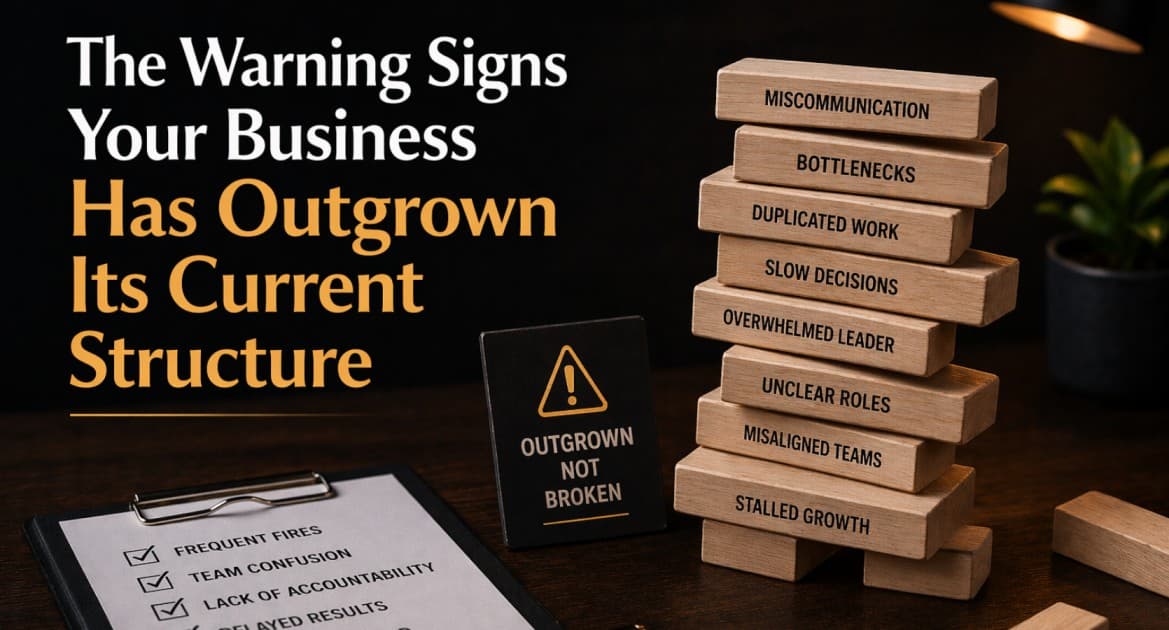
The Warning Signs Your Business Has Outgrown Its Current Structure
Established businesses outgrow structures quietly, until cash, delivery, and compliance start breaking. This article outlines the warning signs directors should treat as structural, not “people problems”, and the operating rules to restore control.
Most established businesses don’t fail because they stop selling. They fail because the structure that worked at one level of complexity becomes dangerous at the next.
As volume, headcount, supplier load, customer concentration, and compliance exposure increase, “how we’ve always done it” turns into hidden risk: unreliable numbers, unclear authority, duplicated effort, uncontrolled spend, inconsistent delivery, and director-level decisions being made on partial information.
If you’re regularly stepping in to resolve issues that should be owned two levels down, that isn’t a motivation issue. It’s structural debt.
Quick Answer
Your business has outgrown its structure when decisions, cash, delivery, and compliance depend on a few individuals rather than defined roles, reporting, and controls. Common signs include inconsistent margins, unreliable management reporting, repeated escalations to the director, unclear accountability, and ad hoc approvals. The fix is not “better leadership” but a reset of decision rights, operating cadence, and internal controls.
The Structure That Got You Here Is Now Creating Risk
Early structures optimize for speed. At scale, speed without controls produces leakage.
A structure is not your org chart. It’s the combined system of:
Decision rights and approval thresholds
Role definitions and accountability
Reporting cadence and management information
Process ownership and control points
Financial governance and cash discipline
Risk management, compliance, and auditability
When these elements lag behind the reality of your operation, the director becomes the operating system. That’s not sustainable, and it’s not defensible when something goes wrong.
If you want an objective baseline before making changes, start with an mrdirector.com.au/#established-business-assessment to identify where the structure is breaking under load.
Warning Sign: You Can’t Get Clean Answers From the Numbers
At scale, “roughly right” is wrong. If reporting is slow, inconsistent, or arguable, you’re running on opinion.
Typical signals:
Monthly results are delivered late and require “explanations” every time
Gross margin moves without a clear driver
WIP, deferred revenue, accruals, and stock are managed inconsistently
Forecasts are optimistic narratives, not reconciled models
You discover problems after the bank balance forces the conversation
This is usually structural, not accounting software. The business lacks a finance operating rhythm, defined owners for data inputs, and clear reconciliation rules. The consequence is predictable: poor decisions, delayed corrective action, and avoidable cash shocks.
If you’re a single decision-maker carrying all commercial and financial calls, the exposure is amplified. Use the mrdirector.com.au/#single-director-business-assessment to pressure-test where your personal decision load is masking structural gaps.
Warning Sign: The Director Is the Bottleneck for Everything That Matters
When a business outgrows its structure, everything gravitates upward. Not because people are incompetent, but because authority is unclear and consequences are uneven.
You’ll notice:
Pricing, credits, exceptions, and urgent customer issues require your sign-off
Hiring and performance decisions are deferred to you by default
Suppliers and contractors bypass managers and contact you directly
Decisions aren’t made until you’re in the room
Managers “update” you but don’t commit to outcomes
This is a decision-rights problem. If you haven’t explicitly defined what must escalate, your calendar becomes the control system. That’s fragile and creates operational drift, because people wait rather than decide.
Warning Sign: Accountability Is Fuzzy and Problems Keep Repeating
If the same issues recur, the issue is not effort. It’s ownership.
Structural indicators:
Projects and deliverables have multiple “owners” and no single accountable person
Operational errors are blamed on workload rather than a broken handoff
Customer complaints repeat because the root cause is not permanently fixed
Internal rework becomes normalised
You have meetings about problems rather than owners resolving them
At scale, unclear accountability becomes expensive quickly. Rework consumes margin, customer trust erodes, and staff start protecting themselves with defensiveness and documentation instead of output.
A functioning structure produces two things:
Clear ownership for outcomes
Clear consequences when standards aren’t met
Without that, you get theatre: activity without control.
Warning Sign: Your Org Chart Reflects History, Not Delivery
Many established businesses carry a legacy org chart that evolved by convenience, tenure, or personality. That’s fine until the delivery system needs coordination and consistent standards.
Red flags:
Roles exist because “that’s what they’ve always done”
Customer experience differs by team, site, or manager
Operations rely on informal relationships rather than defined interfaces
Key processes don’t have an accountable process owner
You have “senior” titles without measurable accountabilities
Structure should map to how value is delivered: sales to fulfilment to invoicing to retention, plus the enabling functions that control risk. If it doesn’t, you get gaps (things nobody owns) and overlaps (multiple people doing the same work differently).
If you want to formalise operating roles and decision rights without overbuilding bureaucracy, the mrdirector.com.au/#download-playbook is the quickest way to set a baseline and stop improvising.
Warning Sign: Cash Flow Is Strong on Paper and Weak in Reality
Scale makes cash dynamics unforgiving. Profit does not equal cash, and growth can be a cash trap if controls lag.
Watch for:
“Surprise” GST, PAYG, super, or payroll obligations
Debtor days drifting because credit discipline is inconsistent
Supplier terms being stretched without a plan
Capex and tool subscriptions accumulating without review
You’re profitable but routinely anxious about liquidity
These are not just finance issues. They’re structural: the business lacks spending authority limits, purchasing controls, disciplined debtor management, and a cash forecast that is owned and actioned.
Directors should treat cash governance as non-negotiable. If the business cannot reliably predict cash position and obligations, it is structurally unsafe.
Warning Sign: Operational Standards Are Inconsistent Across Teams or Sites
When standards depend on who is on shift, you do not have a scalable operation. You have pockets of competence.
Common symptoms:
Quality varies by manager, branch, or crew
Safety and compliance practices differ across sites
Jobs are “done” but not documented, invoiced, or closed correctly
Customer outcomes rely on heroics from a few people
Training is informal and delivered via osmosis
The fix is not micromanagement. The fix is defining the minimum operating standard, assigning ownership for each core process, and building controls that make the right way the default way.
At scale, inconsistency becomes a legal and brand risk, not just an efficiency issue.
Warning Sign: Compliance and Risk Controls Are Informal or Person-Dependent
In established businesses, governance failures are rarely dramatic at first. They show up as small exceptions that become normal.
Examples:
Contracts are signed without review because “we’ve always used this template”
HR issues are handled ad hoc until they become claims
Safety documentation exists but is not enforced in practice
Data access and approvals are based on trust, not controls
Key person knowledge is the only control
If you cannot demonstrate how decisions were made, who approved what, and what controls exist, you are exposed. Not hypothetically. Practically.
Directors should assume that if an incident occurs, the business will be judged on systems, not intentions. Auditability matters because you cannot defend what you cannot evidence.
Warning Sign: Meetings Multiply but Decisions Don’t Stick
More meetings is not coordination. It’s a symptom of structural ambiguity.
You’ll see:
The same topics appear weekly with no resolution
Meetings are status updates, not decision forums
People leave meetings with different interpretations of what was decided
Follow-through depends on personal reminders from the director
Priorities change mid-week because there is no cadence
A business that has outgrown its structure needs an operating cadence that creates rhythm:
What gets reviewed weekly vs monthly
Who attends which forums
What decisions are made there
What metrics define “in control”
What actions must be closed before the next meeting
Without cadence, you don’t have management. You have continuous interruption.
Warning Sign: Systems Sprawl and Workarounds Have Become Normal
As volume increases, teams build local solutions: spreadsheets, shadow CRMs, email approvals, “quick” processes. Eventually the business becomes a patchwork of workarounds.
Indicators:
Multiple sources of truth for customers, pricing, inventory, or jobs
Sales promises that operations can’t see or verify
Manual reconciliations that rely on one person’s spreadsheet
People bypass the system because it’s too hard or too slow
Data quality is inconsistent and nobody owns it
Systems issues are usually structure issues first. If there is no process owner and no standard, the software cannot fix it. The business needs to define:
The required workflow
The data fields that matter
The owners responsible for data integrity
The control points where errors are caught early
Then you align systems to that operating model, not the other way around.
Director Rules
These are non-negotiable operating rules directors should implement once the business has outgrown its current structure. If you don’t set them, the business will set its own rules through habit and politics.
1. One owner per outcome
Every core deliverable must have a single accountable owner with clear success metrics. Shared ownership is a euphemism for no ownership.
2. Decision rights must be explicit
Define who can approve pricing changes, credits, hiring, capex, supplier changes, and exceptions. Publish thresholds. Enforce them.
3. Management reporting is a control system, not a document
Agree on a small set of metrics that indicate control across cash, margin, delivery, and risk. Lock the definitions. Review on a fixed cadence.
4. Controls must be designed for normal weeks, not crisis weeks
If your controls only work when you personally intervene, they are not controls. Build routines that operate without heroics.
5. If it isn’t auditable, it isn’t real
Key decisions, approvals, and compliance actions must be evidenced. Verbal agreements and “everyone knows” will fail under scrutiny.
Director Actions This Week (Checklist)
Identify the top five decisions currently bottlenecked at director level and define decision rights, thresholds, and escalation rules for each
Choose one weekly control meeting and convert it into a decision forum with a fixed agenda, required inputs, and action close requirements
Lock definitions for core numbers: gross margin, WIP (if applicable), debtor days, and forward cash position, and assign an owner for each input
Map the end-to-end delivery chain and assign an accountable process owner to each major stage from sale to fulfilment to invoicing to collections
Implement a spend control rule: purchase approval thresholds, supplier onboarding rules, and a subscription review owner
Identify two recurring operational failures and require root-cause fixes with a named owner, due date, and control point to prevent recurrence
Document the minimum compliance baseline relevant to your operation and nominate one accountable owner for evidence and enforcement
Remove one major workaround by defining the required workflow and enforcing a single source of truth
FAQs
1. What’s the difference between “growing pains” and outgrowing structure?
Growing pains are temporary load issues where the current structure still holds. Outgrowing structure is when recurring problems persist despite effort because authority, ownership, reporting, and controls are not designed for current complexity.
2. Should I restructure people first or fix reporting and decision rights first?
Fix decision rights and reporting first. Without clarity on authority and the numbers, you’ll reshuffle titles and still have the same bottlenecks, repeated escalations, and inconsistent standards.
3. How do I know if the issue is a weak manager or a weak structure?
If multiple capable people struggle in the same role, it’s structural. If performance improves only when you personally intervene, it’s structural. If outcomes vary wildly by team with the same resources, it’s structural.
4. What’s the fastest way to reduce director workload without losing control?
Define decision rights with thresholds, implement a weekly operating cadence with a small set of control metrics, and assign single-point accountability for core processes. Director workload drops when control is embedded in routines, not in you.
5. When should an established business bring in external help for a structural reset?
When you can see the warning signs but internal politics, legacy roles, or decision fatigue prevent change. External support is most valuable when it drives clear operating rules, accountability, and governance that the business will actually enforce.