
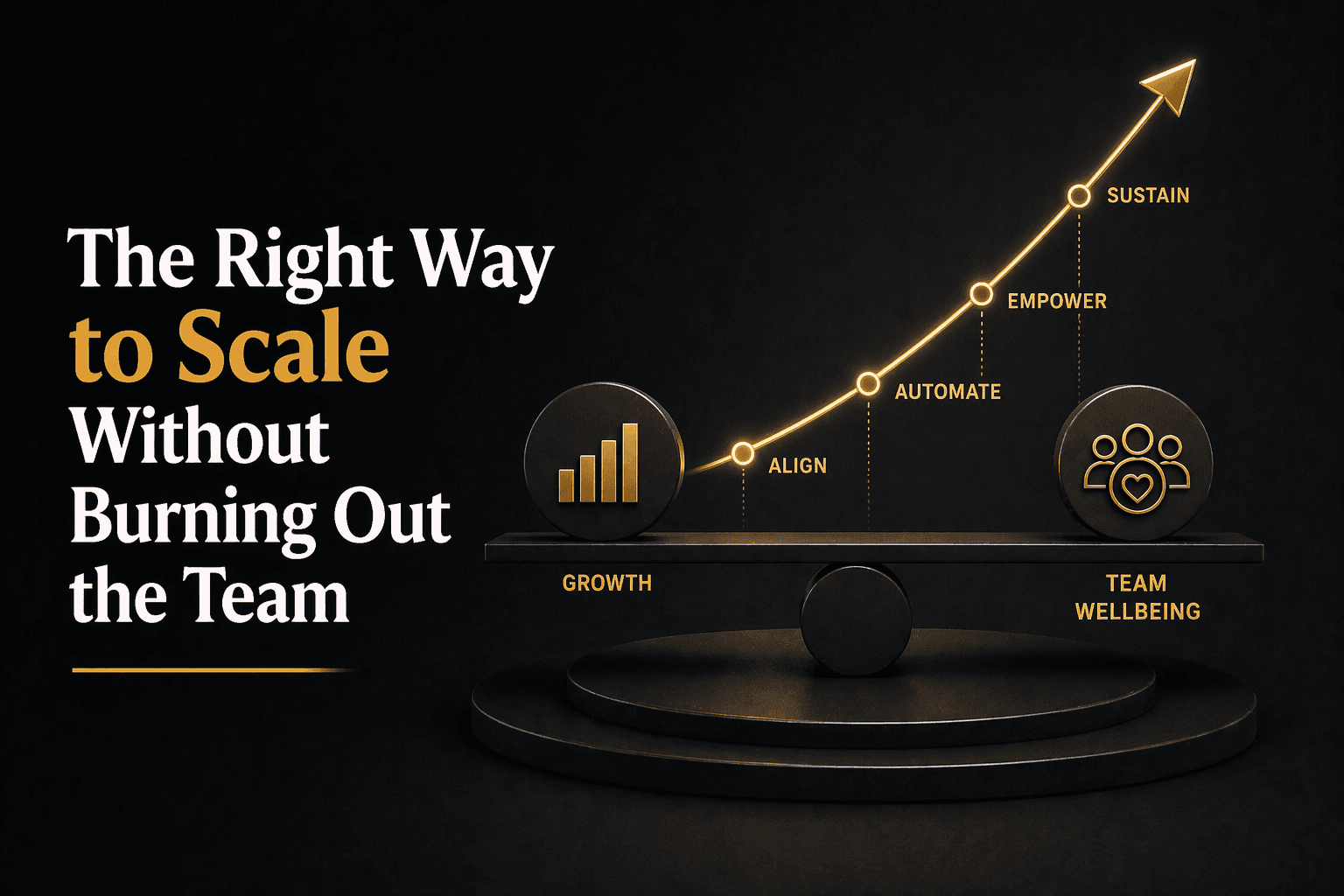
The Right Way to Scale Without Burning Out the Team
Rapid growth can overload teams, damage culture, and create operational fragility if structure does not evolve with scale. This article explains how directors implement systems, operating cadence, and management accountability to expand capacity without exhausting staff or increasing organisational risk.
The Right Way to Scale Without Burning Out the Team
Growth places pressure on people before it places pressure on systems.
More clients, more delivery commitments, more communication, more reporting, and more internal coordination all converge on the same operational layer. Teams that performed effectively at one scale suddenly find themselves operating beyond sustainable capacity.
In many established businesses, the response is predictable. Staff work longer hours. Managers attempt to absorb the pressure. Directors intervene to maintain delivery standards.
Short-term performance is preserved, but structural damage begins.
Burnout is rarely caused by a single difficult week. It develops when the organisation grows faster than its operating structure.
Directors who intend to scale must treat capacity management as a governance issue, not a cultural one.
Quick Answer
Businesses scale without burning out teams when directors build operational capacity before increasing workload. This requires clear decision rights, documented delivery standards, realistic capacity planning, management accountability, and structured operating cadence. Without these systems, growth overloads staff, weakens quality, increases turnover, and introduces operational risk.
Growth Increases Workload Faster Than Capacity
Every additional client, project, or service expansion creates incremental workload.
The increase is not linear. It multiplies across coordination points.
When a business grows, the following pressures appear simultaneously:
More internal communication between teams
Increased client expectations for responsiveness
Higher administrative workload
Expanded reporting requirements
More complex scheduling and resource allocation
If the organisation expands workload without expanding its structural capacity to manage that workload, pressure accumulates inside the team.
Staff compensate initially. Productivity rises through extra effort.
Eventually the organisation reaches a point where effort alone cannot compensate for structural limits.
Burnout is the visible symptom of a structural imbalance between demand and capacity.
Directors who want to identify where this imbalance is already occurring can start with the diagnostic inside mrdirector.com.au/#established-business-assessment, which highlights structural weaknesses that usually appear before team fatigue becomes obvious.
Directors Often Scale Revenue Before Structure
A common pattern in established businesses is revenue-led scaling.
Sales performance improves. Market demand increases. Client acquisition accelerates.
Operational structure is adjusted afterward.
This sequence introduces risk because operational capacity is reactive rather than planned.
Symptoms appear quickly:
Teams working extended hours to maintain delivery
Managers firefighting instead of managing
Client commitments made without delivery capacity analysis
Increasing internal communication breakdowns
Directors sometimes interpret these signals as temporary growing pains.
In reality, they are early indicators that structure has not kept pace with demand.
Scaling sustainably requires the opposite sequence.
Capacity must be built before workload increases.
The Hidden Cost of Continuous Urgency
Organisations under constant pressure develop urgency as a default operating mode.
Every task appears critical. Every request is treated as immediate. Staff move continuously from one urgent issue to another.
This environment appears productive in the short term.
However, continuous urgency produces several predictable effects:
Reduced decision quality
Increased operational errors
Poor documentation of decisions
Staff exhaustion and disengagement
Declining client experience consistency
Urgency is a temporary response to a specific situation.
When urgency becomes permanent, it indicates structural overload.
Directors must distinguish between genuine critical events and operational environments that have normalised pressure.
Scaling organisations require stability in daily operations.
Management Layers Must Absorb Operational Pressure
As organisations grow, the role of management becomes critical.
Managers exist to absorb operational complexity so directors can focus on governance and strategic oversight.
However, many businesses create management titles without creating management authority.
Managers may supervise staff but lack:
Authority to make operational decisions
Control over resource allocation
Responsibility for performance outcomes
When authority is unclear, operational pressure bypasses management and returns directly to the director.
This creates two problems simultaneously.
The director becomes a bottleneck, and managers never develop full ownership of their function.
Effective scaling requires managers who own outcomes, not managers who escalate problems upward.
If the business currently relies on a single decision hub, the exposure is even higher. Directors in that position should review the structural risks using mrdirector.com.au/#single-director-business-assessment
Capacity Planning Must Replace Assumption
Many organisations expand workload based on assumptions about team capacity.
Directors assume the team can absorb additional projects because performance has historically been strong.
However, without structured capacity planning, these assumptions are unreliable.
Capacity planning requires visibility into:
Average delivery time per project or client
Staff availability and utilisation rates
Administrative workload per operational unit
Peak workload periods
Recovery time required between high-pressure periods
Without this data, new work is accepted based on optimism rather than operational reality.
Burnout often begins when accepted commitments exceed the team’s sustainable capacity.
Documented Systems Reduce Cognitive Load
When processes are undocumented, every task requires interpretation.
Staff must decide how to complete work each time it occurs. Managers must review work more frequently. Directors intervene to maintain standards.
This increases cognitive load across the organisation.
Documented systems reduce this burden.
Systems provide:
Clear delivery standards
Defined process steps
Expected timelines
Quality benchmarks
When systems exist, staff execute tasks without needing to interpret expectations repeatedly.
Operational clarity is a key factor in preventing team exhaustion during growth.
Decision Bottlenecks Increase Stress
When directors remain involved in operational decisions, decision throughput slows.
Staff wait for approvals. Managers delay commitments. Work pauses while leadership availability is confirmed.
These pauses create pressure later in the process when deadlines approach.
Teams then rush to complete tasks within compressed timeframes.
This pattern produces an artificial cycle of pressure.
Work slows while awaiting decisions, then accelerates under deadline pressure.
Clear decision rights remove unnecessary waiting and distribute authority appropriately.
Frameworks that help establish these decision rules and operating cadence are outlined in mrdirector.com.au/#download-playbook
Sustainable Scaling Requires Predictable Cadence
Organisations that scale successfully operate on predictable rhythms.
Rather than reacting continuously to emerging problems, they review performance and make decisions at scheduled intervals.
A structured operating cadence typically includes:
Weekly performance reviews by functional area
Weekly financial visibility across cash flow and pipeline
Monthly operational planning sessions
Monthly compliance and risk reviews
Quarterly strategic planning
Predictable cadence reduces uncertainty within teams.
Staff know when issues will be addressed and where decisions will be made.
This stability allows managers to focus on delivery rather than constant escalation.
Culture Deteriorates When Pressure Becomes Permanent
Burnout does not occur only because of workload. It occurs when staff perceive that pressure is endless.
In high-performing teams, staff accept periods of intensity when they believe it is temporary and purposeful.
However, when pressure becomes constant, engagement declines.
Signs of cultural deterioration include:
Increasing staff turnover
Reduced initiative from experienced employees
Declining collaboration between teams
Growing resistance to additional work
Directors sometimes attempt to address these symptoms with morale initiatives or incentives.
These interventions rarely solve the problem because the root cause is structural.
Healthy organisational culture depends on sustainable operational systems.
Director Framework
Directors who intend to scale without exhausting their teams must implement structural controls.
Capacity Visibility System
Track workload demand against available operational capacity to prevent overcommitment.Delegation and Decision Rights
Define operational decisions that managers can make independently and establish escalation thresholds.Documented Operating Systems
Standardise delivery processes, timelines, and quality benchmarks across the organisation.Operating Cadence
Implement weekly and monthly review rhythms that surface issues before pressure escalates.Management Accountability Structure
Assign clear ownership of outcomes within each operational function.
These systems allow directors to scale delivery without scaling exhaustion.
Director Actions This Week
Review current team workload against delivery capacity
Identify operational decisions currently waiting for director approval
Assign clear decision rights to appropriate managers
Document the most frequently repeated operational processes
Implement a weekly performance review cadence with management
Identify functions where workload has increased without structural support
Conduct a short staff capacity review with department managers
FAQs
Why does growth often cause team burnout?
Growth increases workload and operational complexity. If systems, management structures, and capacity planning do not evolve simultaneously, staff absorb the additional pressure until exhaustion occurs.
Can hiring more staff solve burnout during growth?
Additional hiring helps only when roles, responsibilities, and processes are clearly defined. Without structural clarity, new staff increase coordination complexity rather than relieving pressure.
How can directors detect early signs of team burnout?
Early signals include declining delivery consistency, increased staff turnover, reduced initiative from experienced employees, and managers reporting constant operational pressure.
Is burnout mainly a cultural problem?
Burnout is usually structural rather than cultural. It occurs when workload consistently exceeds operational capacity due to poor planning, unclear decision rights, or inadequate systems.
What is the first step to scaling sustainably?
The first step is establishing visibility into operational capacity and workload demand. Directors must understand whether the organisation can absorb additional commitments before pursuing growth.