
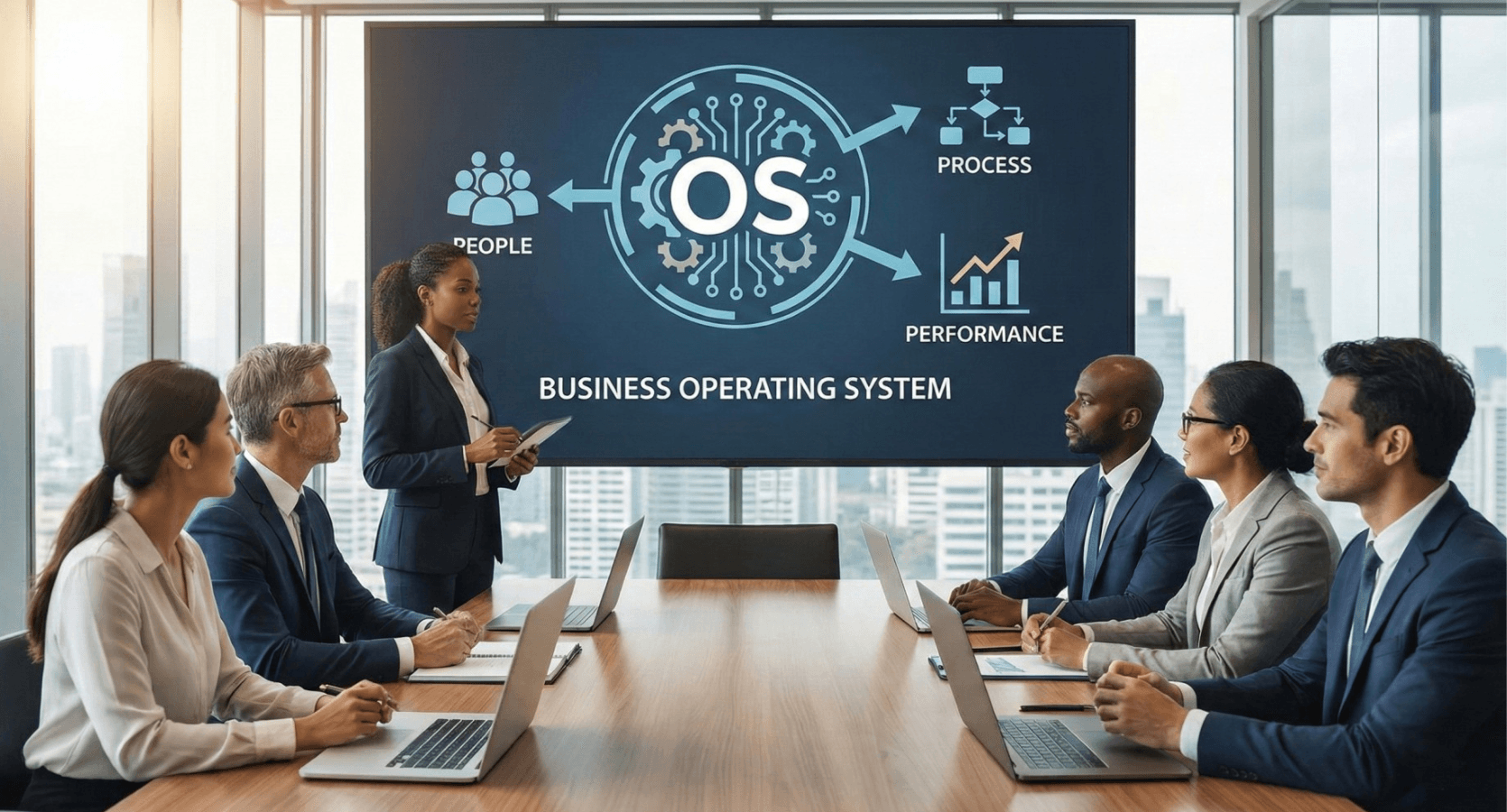
The Operating System Every Business Needs to Scale
Most businesses don’t fail because of lack of demand. They fail because the business relies on the owner for decisions, delivery, and stability. This guide explains the operating system every scaling business needs: clear roles, scoreboards, weekly rhythms, process ownership, accountability, and decision structure. It’s the foundation for consistent performance, predictable profit, and growth without chaos.
If Your Business Still Relies on You, You’re Not Scalable Yet
Most directors think scaling is about:
marketing
sales
lead volume
more staff
Those matter.
But they’re not what decides whether you can scale.
Scaling is decided by one thing:
Does the business run without the director being the system?
If every problem lands on you,
If every decision needs you,
If the team can’t execute without you,
You’re not running a business.
You’re running a personal production machine with overhead.
And growth won’t free you.
It will trap you harder.
This is why scalable businesses install an operating system, not just processes.
If you want to diagnose whether your business is operating-system ready, start with the mrdirector.com.au/#established-business-assessment
What “Operating System” Actually Means (And Why You Need One)
A business operating system is not software.
It’s the structure that makes the business execute consistently.
It controls:
how decisions are made
how work flows
how standards are enforced
how performance is measured
how accountability is assigned
how leadership runs weekly
how issues are solved before they become fires
It’s the difference between:
a business that scales
and
a business that grows chaos.
Directors who scale don’t rely on motivation.
They rely on a system that forces consistency.
The Problem: Owner-Led Execution Is the Scaling Ceiling
There’s a stage every business hits where:
demand exists
the team is growing
work is flowing
revenue is rising
but the director becomes the bottleneck.
Because the business still depends on the owner to:
decide priorities
approve everything
solve issues
keep clients happy
fix mistakes
hold standards
keep momentum
That’s not leadership.
That’s being the operating system.
And it doesn’t scale.
The Operating System Every Scaling Business Needs (Director Framework)
Here’s the truth:
You don’t need 50 systems.
You need one operating system that controls the business across five pillars:
Leadership & accountability
Scoreboards & visibility
Process ownership & execution
Weekly operating rhythm
Issue resolution & decision structure
This is the foundation.
Everything else sits on top of it.
Pillar 1: Leadership Structure (Roles, Ownership, Accountability)
Most businesses struggle because roles are unclear.
Everyone is doing everything.
No one owns outcomes.
Problems bounce around.
Scaling requires clarity.
Director must define:
who owns delivery
who owns sales and pipeline
who owns operations
who owns finance/cash discipline
who owns client experience
Even if some roles are combined early, ownership must be clear.
If everyone owns it, no one owns it.
Pillar 2: The Scoreboard (If You Can’t See It, You Can’t Control It)
Scaling businesses run on scoreboards, not vibes.
Your scoreboard should include:
sales pipeline (leads, conversion, close rate)
delivery capacity (active jobs, deadlines, bottlenecks)
quality metrics (rework, complaints, missed standards)
cash discipline (receivables, collections targets, cash forecast)
profitability (gross margin, job margin trend, overhead creep)
You don’t need complex reporting.
You need a small set of numbers reviewed weekly.
Directors don’t “hope.”
They measure.
Pillar 3: Process Ownership (Systems People Actually Follow)
Systems fail when they’re:
long
stored in folders
not embedded in workflow
optional
Scaling requires systems that are:
simple
executable
connected to tools your team uses
enforced by leadership
Director rule:
A system without ownership is a document, not a process.
Every critical process needs an owner who:
trains it
maintains it
audits compliance
improves it monthly
Pillar 4: Weekly Operating Rhythm (The Engine Room of Scale)
If your business doesn’t have a weekly rhythm, you’re reactive.
Reactive businesses burn out as they scale.
Your operating system needs a weekly cadence that covers:
performance review
capacity planning
priorities
blockers
accountability
decisions
The Director Weekly Rhythm
Monday: priorities + capacity + forecast review
Midweek: delivery and quality check
Friday: scoreboard review + issue list + decisions
This rhythm creates:
consistency
predictability
less firefighting
better execution
You don’t scale with hustle.
You scale with rhythm.
If you want this structured into templates and systems, use mrdirector.com.au/#download-playbook
Pillar 5: Issue Resolution (Stop Repeating the Same Problems)
Scaling businesses don’t “handle issues.”
They eliminate them.
Most businesses repeat issues because:
problems aren’t logged
root causes aren’t addressed
fixes are temporary
no one owns prevention
leadership is too busy reacting
A real operating system includes:
an issue register
weekly issue review
root cause analysis
assigned owners
deadlines
follow-through
The goal isn’t to solve problems quickly.
The goal is to stop them returning.
The Operating System Implementation Sequence (Don’t Do Everything at Once)
This is where directors get it wrong.
They try to systemise everything.
That fails.
Implement in this order:
Install leadership roles and ownership
Set your weekly scoreboard
Define your weekly meeting rhythm
Build critical path systems (delivery, quoting, invoicing, quality)
Install issue resolution and continuous improvement
You don’t scale by building more.
You scale by tightening control.
What Happens When You Install a Real Operating System
When the operating system is installed, directors experience:
fewer surprises
more predictable delivery
less reliance on the owner
improved team accountability
stronger margin discipline
better cashflow control
calmer growth
The business becomes a machine, not a mess.
That’s what scale feels like.
The Director Reality Check: If You Don’t Install This, Growth Will Punish You
Growth doesn’t reward disorganisation.
Growth punishes it.
If you don’t install an operating system, scaling will amplify:
staff issues
delivery failures
client churn
margin collapse
cash stress
director burnout
The director doesn’t need more effort.
The director needs more structure.
Director Actions This Week
Install Your Operating System
Define ownership for sales, delivery, operations, and finance
Build a weekly scoreboard (5–10 key numbers)
Lock a weekly leadership meeting rhythm
Identify your critical path processes
Assign process owners
Create one-page SOPs + embedded checklists
Implement “definition of done” standards
Start an issue register and review weekly
Stop making decisions based on gut feel
Diagnose readiness to scale: mrdirector.com.au/#established-business-assessment
FAQs
1) What is a business operating system?
A framework that drives consistent execution across leadership, accountability, processes, metrics, and weekly rhythm. It’s how businesses scale without chaos.
2) Why do businesses struggle to scale?
Because operations rely too heavily on the owner, systems are optional, and accountability is unclear. Growth amplifies these weaknesses.
3) What are the key parts of an operating system?
Leadership ownership, scoreboards, process systems, weekly rhythms, and issue resolution.
4) How long does it take to install an operating system?
It depends on complexity and leadership consistency, but the first measurable improvement usually comes from installing roles, scoreboards, and rhythm quickly.
5) Do I need software to run an operating system?
No. Software can support it, but the operating system is primarily structure, discipline, and leadership rhythm.
6) What’s the first system to build?
Start with the critical path: quoting, delivery, invoicing, quality control, and cash discipline.
If your business still relies on you to hold it together, scaling will keep increasing pressure. Start with the mrdirector.com.au/#established-business-assessment and get clarity on what structure you need to install first.