
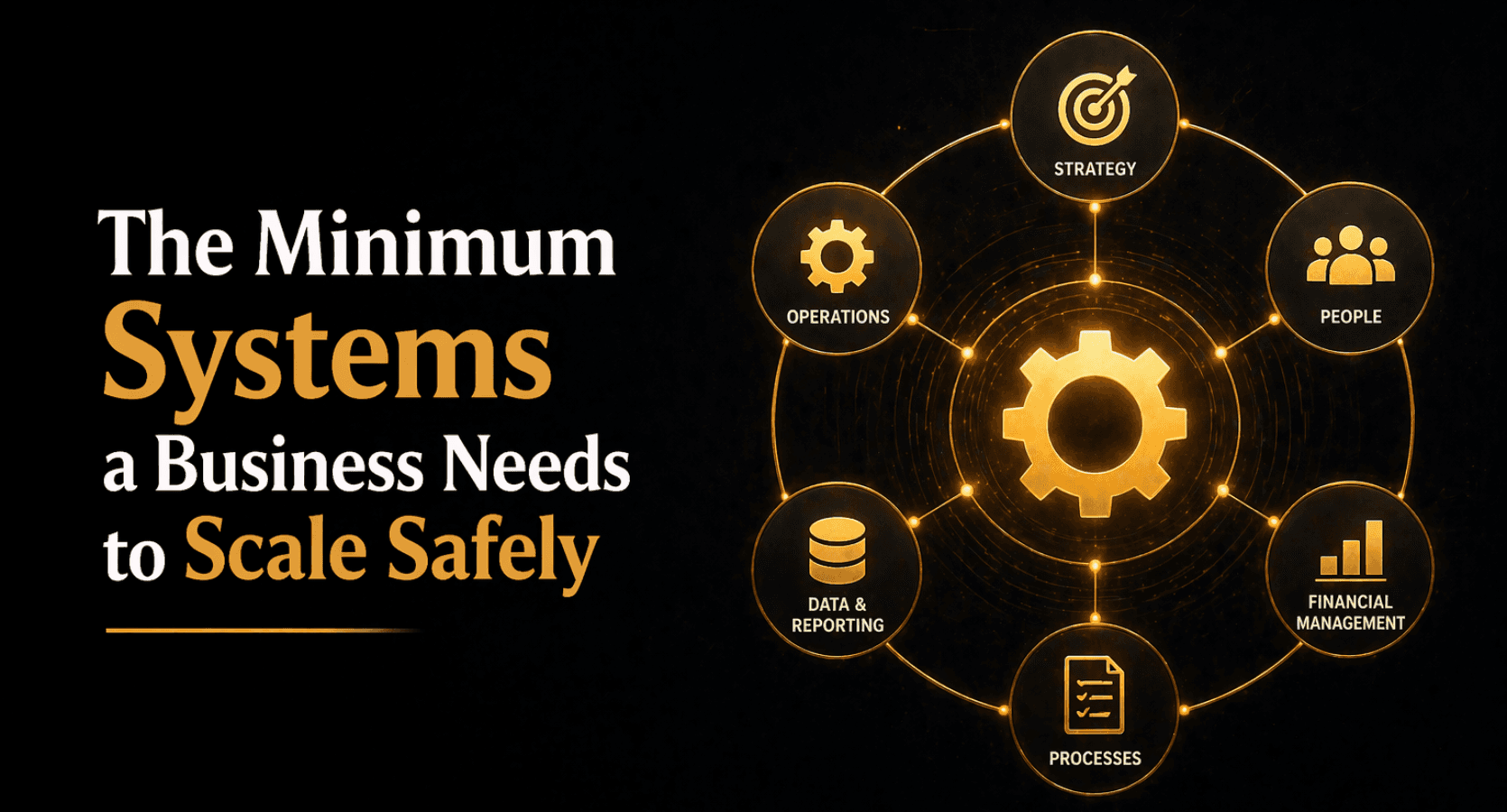
The Minimum Systems a Business Needs to Scale Safely
Scaling without systems increases risk. Discover the minimum business systems required to grow safely and protect margins, quality, and stability.
Scaling without structure increases exposure.
Growth multiplies pressure.
More clients.
More staff.
More moving parts.
Without minimum viable systems, expansion increases volatility instead of enterprise value.
Businesses rarely collapse from lack of ambition.
They collapse from unmanaged complexity.
Safe scale requires structural coverage across revenue, operations, finance, and leadership.
Anything less is fragile growth.
Quick Answer
A business can scale safely only when four minimum system categories are installed:
Revenue System
Operational Delivery System
Financial Control System
Leadership Accountability System
Each must be documented, measured, and reviewed consistently.
If even one relies on memory, personality, or constant intervention, risk increases.
Director Rule:
Growth without systems is unmanaged risk.
The Minimum Viable Systems Framework
This is not about bureaucracy.
It is about control.
The objective is not perfection.
The objective is protection.
System 1: Revenue Predictability System
Expansion without revenue structure creates instability.
Minimum components:
1. Defined Lead Sources
Identified primary and secondary channels
Weekly lead tracking
Cost per acquisition visibility
2. Structured Sales Process
Standardised discovery framework
Qualification criteria
Defined close sequence
3. Pricing Framework
Margin-based pricing
Minimum engagement thresholds
Clear discount policy
Director Rule:
Revenue must be predictable before it is expanded.
Practical Example:
Unsafe Expansion:
Revenue depends on referrals.
Sales conversations vary widely.
Pricing shifts under pressure.
Safe Expansion:
Lead channels tracked weekly.
Sales meeting agenda fixed.
Pricing anchored to margin targets.
Predictability reduces stress and protects cash flow.
System 2: Operational Delivery Control
Growth increases delivery strain.
Without structured execution, quality declines.
Minimum components:
1. Onboarding Checklist
Defined first 14–30 days
Internal responsibility allocation
Communication timeline
2. Core Workflow Map
Step-by-step service stages
Defined handover points
Quality checkpoints
3. Scope Management Process
Change request procedure
Variation pricing approval
Escalation pathway
Director Rule:
Delivery inconsistency is reputational risk.
If outcomes vary depending on who handles the work, the system is insufficient.
Safe scale requires repeatable client experience.
System 3: Financial Control and Visibility
Revenue growth without financial clarity creates hidden exposure.
Minimum financial systems:
1. 90-Day Cash Forecast
Forward-looking cash visibility
Best and worst-case scenarios
Fixed cost baseline
2. Weekly Revenue Dashboard
Closed sales
Pipeline value
Conversion rate
3. Margin Monitoring
Gross margin by service line
Monthly expense review
Break-even threshold visibility
Director Rule:
Cash clarity eliminates reactive decisions.
Expansion timing must be informed by data.
Without forward visibility, growth decisions are assumptions.
System 4: Leadership and Accountability Structure
As complexity increases, leadership must become structured.
Control must shift from personality to accountability.
Minimum leadership systems:
1. Defined Role Scorecards
Clear outcomes per role
Quantifiable KPIs
Reporting cadence
2. Weekly Leadership Meeting Agenda
Revenue review
Operational bottlenecks
Financial position
Accountability review
3. Decision Rights Framework
Who approves pricing
Who authorises hiring
Who manages disputes
Who controls discounts
Director Rule:
Accountability must be structural, not emotional.
Founder dependency increases risk and limits scalability.
Leadership systems reduce both.
The Risk Multiplier Effect
Scaling without systems amplifies five exposures:
Cash Flow Volatility
Margin Compression
Service Inconsistency
Staff Burnout
Founder Exhaustion
Each compounds as complexity grows.
Systems do not eliminate risk.
They contain it.
What “Minimum” Does Not Mean
Minimum does not mean superficial.
Minimum means:
Documented
Measured
Reviewable
Assigned to roles
Independent of memory
Director Rule:
If it lives in someone’s head, it is not a system.
Common Scaling Mistakes
Hiring before systemising
Headcount magnifies disorder.Expanding marketing without delivery control
Increased demand exposes weakness.Confusing software with systems
Tools automate chaos if structure is unclear.Ignoring margin erosion
Revenue growth can hide declining profitability.Avoiding pricing discipline
Scale requires margin protection.
Structure precedes expansion.
Always.
The Safe Scaling Rhythm
Systems require cadence.
Weekly:
Revenue dashboard review
Pipeline tracking
Operational bottleneck identification
Monthly:
Margin analysis
Cost review
System refinement
Quarterly:
Strategy adjustment
Pricing review
Capacity planning
Director Rule:
Review cadence protects stability.
Without rhythm, systems deteriorate.
Practical Case: Service Firm Under Pressure
Before Systems:
Founder closes majority of deals.
Onboarding inconsistent.
Financial position reviewed reactively.
Staff unclear on expectations.
After Minimum Systems Installed:
Sales framework implemented.
Delivery workflow mapped.
Cash forecast active.
KPIs documented per role.
Results:
Higher conversion rate.
Reduced operational errors.
Improved margin stability.
Lower founder involvement in daily decisions.
Scale became controlled.
Director Actions This Week
Install structural protection.
Checklist:
Document primary lead channels
Create standard sales call framework
Implement 90-day cash forecast
Map core service workflow
Define KPIs for each key role
Schedule weekly leadership review
Identify top operational bottleneck
Clarify pricing floor and margin targets
Do not increase marketing or hiring until these are operational.
FAQs
1. Can a business scale without documented systems?
Short-term growth is possible.
Sustainable scale is not.
2. How detailed should systems be?
Detailed enough to ensure consistency and accountability.
Perfection is unnecessary. Clarity is essential.
3. What if revenue is strong but operations are inconsistent?
Expansion should pause until delivery control stabilises.
4. When should hiring occur?
After revenue and delivery systems are documented and measurable.
5. Do systems reduce flexibility?
No. They create stability that enables strategic decisions.
6. How do systems increase business valuation?
Reduced dependency increases transferability.
Transferability increases valuation multiples.
Safe Scale Is Structured Scale
Ambition without infrastructure increases exposure.
Established businesses do not need more effort.
They need structural coverage across revenue, operations, finance, and leadership.
Growth becomes safe when risk is contained.
Next Step: Identify Structural Gaps
Most Directors underestimate where exposure hides.
Complete the Mr Director Business Assessment to evaluate system strength across Revenue, Operations, Finance, and Leadership.
Or implement the Mr Director Playbook to install structured scale with precision.
Scale deliberately.
Scale safely.