
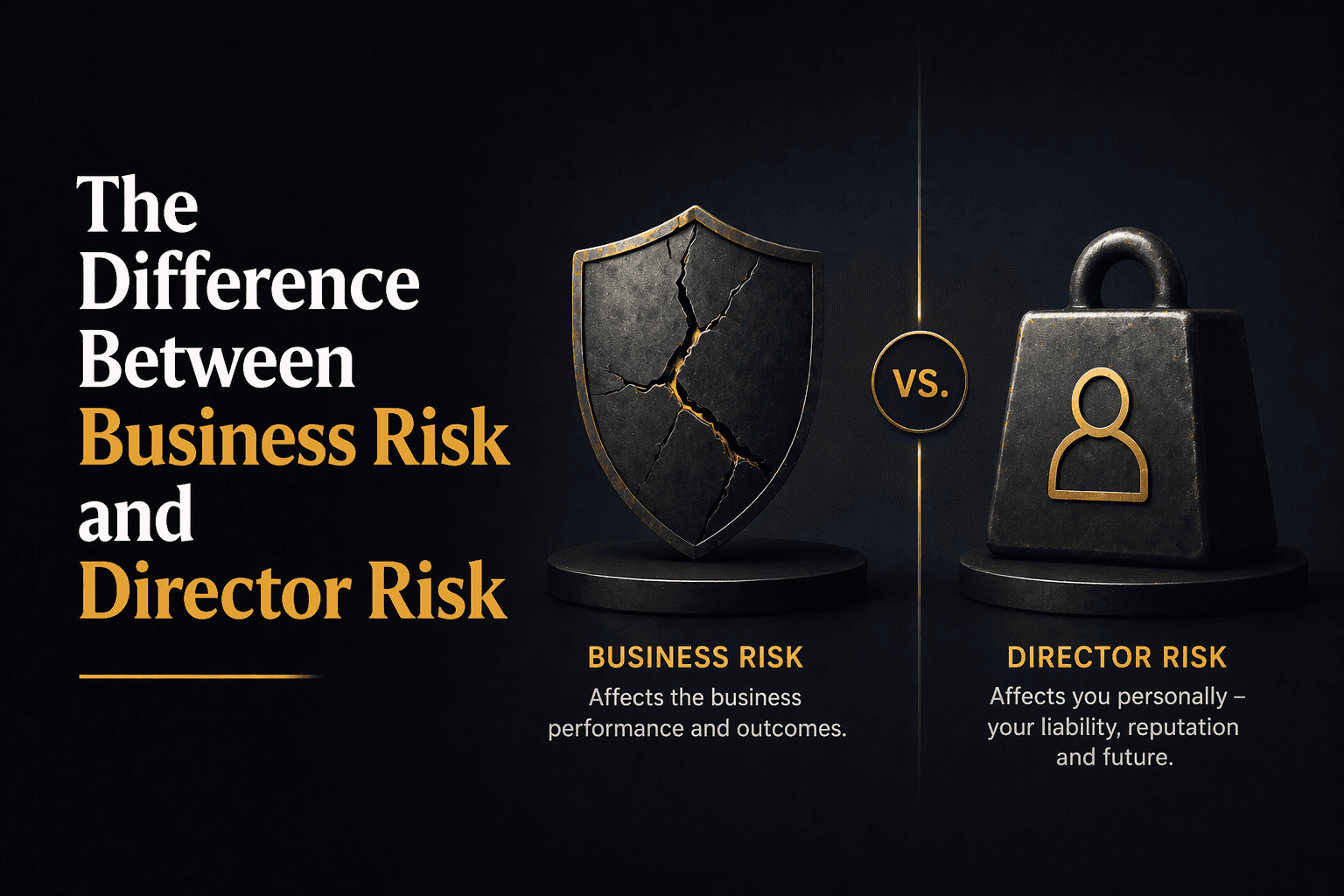
The Difference Between Business Risk and Director Risk
Business risk affects performance. Director risk affects personal liability. As companies scale, the distinction becomes critical. This article outlines how operational exposure differs from director-level legal and financial responsibility, and the governance systems required to protect both the organisation and the individual carrying statutory duty.
The Difference Between Business Risk and Director Risk
Most established businesses manage operational risk. Far fewer directors actively manage director risk.
The distinction is not semantic. It is structural.
Business risk relates to the organisation’s exposure to loss, volatility, disruption, or underperformance. Director risk relates to the personal legal, financial, and reputational exposure carried by the individual who holds statutory responsibility for that organisation.
As complexity increases, these risks diverge.
A business can survive operational mistakes. A director may not survive personal liability exposure triggered by those same mistakes.
Understanding the difference is not theoretical. It determines whether governance systems are designed for performance or protection.
Quick Answer
Business risk refers to operational, financial, and strategic exposures affecting company performance. Director risk refers to the personal legal and financial liability directors carry under corporate and regulatory law. As businesses scale, director risk increases independently of business performance. Strong revenue and operational stability do not eliminate personal exposure arising from compliance breaches, insolvent trading, or governance failures.
What Is Business Risk?
Business risk encompasses the uncertainties that impact company performance, profitability, and continuity.
In established businesses, these risks are typically managed through operational systems and financial controls.
Common categories include:
Revenue volatility
Margin compression
Supplier dependency
Market competition
Operational inefficiency
Technology failure
Staff
Contractual disputes
These risks affect earnings, cash flow, and growth trajectory.
They are commercial risks.
When business risk materialises, the company absorbs the consequence through reduced profit, increased cost, reputational damage, or restructuring.
The entity carries the loss.
Business risk is expected. It is inherent in commercial activity.
What Is Director Risk?
Director risk arises from statutory duties and fiduciary obligations imposed on individuals who govern corporations.
Directors are not insulated by the corporate veil in all circumstances.
Director risk includes exposure arising from:
Insolvent trading
Breach of fiduciary duty
Failure to act with due care and diligence
Misuse of position or information
Workplace health and safety breaches
Superannuation and tax compliance failures
Privacy and data protection breaches
Failure to prevent regulatory misconduct
Unlike business risk, director risk is personal.
Regulators, courts, and liquidators may pursue directors individually when governance failures occur. Penalties can include financial penalties, disqualification, compensation orders, and reputational damage.
The company’s survival does not eliminate director exposure.
Director risk is legal, not commercial.
Why Performance Does Not Eliminate Director Risk
One of the most dangerous assumptions in established businesses is that strong performance equates to low exposure.
A company can report profitability while carrying material director risk.
Examples include:
Trading while technically insolvent due to poor cash flow visibility
Failing to remit superannuation despite positive profit reporting
Signing contracts outside delegated authority
Inadequate oversight of workplace safety compliance
Weak documentation of board decisions
Performance metrics measure output. They do not measure compliance discipline.
Director risk increases when governance systems lag behind operational scale.
The assumption that revenue strength equals structural safety is incorrect.
The Corporate Veil Is Not Absolute Protection
Many directors rely on the concept of limited liability without understanding its limits.
Limited liability protects shareholders from company debts in most circumstances. It does not protect directors from breaches of statutory duty.
Director risk overrides corporate structure in areas such as:
Insolvent trading
Director penalty notices for unpaid tax
Superannuation guarantee charge liabilities
Serious workplace health and safety breaches
Certain environmental and regulatory offences
When regulatory thresholds are crossed, personal assets can become exposed.
Directors must distinguish between business loss and personal liability trigger points.
The corporate structure is not a substitute for governance discipline.
Operational Complexity Increases Director Exposure
As businesses scale, operational complexity increases across staffing, compliance, contracts, and financial obligations.
Director risk expands proportionally.
Areas of heightened exposure during growth include:
Increased payroll and employment law obligations
Expanded contractor networks
Multi-site operations
Cross-jurisdictional regulatory compliance
Higher transaction volumes
Increased data storage and privacy risk
Directors often delegate operational responsibility without increasing governance oversight.
Delegation does not transfer statutory duty.
The larger the organisation, the greater the need for formalised reporting and compliance systems to protect the director.
Insolvent Trading: Where Business and Director Risk Collide
Insolvent trading is a primary intersection between business risk and director risk.
A business experiencing cash flow strain faces commercial risk. A director allowing trading to continue while the company cannot meet its obligations faces personal liability.
Insolvency is not determined by profit reporting alone. It is determined by the company’s ability to pay debts as they fall due.
Common blind spots include:
Reliance on projected revenue not yet received
Delayed creditor payments to preserve liquidity
Tax liabilities deferred without structured plan
Inadequate cash forecasting beyond immediate obligations
Directors must actively assess solvency, not assume it.
When cash visibility is weak, director risk increases significantly.
Governance Failure as Director Exposure
Business risk often focuses on performance indicators. Director risk focuses on governance integrity.
Governance failures that elevate director exposure include:
Lack of documented board resolutions
Inadequate oversight of financial reporting
Failure to question management assumptions
Conflicts of interest not declared
Absence of formal risk register
Regulators assess director conduct against standards of care and diligence.
The question is not whether the business performed well. It is whether the director exercised reasonable oversight.
Governance documentation is protective evidence.
Without it, directors rely on memory and informal process under scrutiny.
Compliance Breaches and Personal Liability
Certain compliance failures move directly from business issue to director issue.
Examples include:
Failure to remit PAYG withholding
Unpaid superannuation
Systemic workplace safety breaches
Privacy law violations involving negligence
Misleading or deceptive conduct
Regulatory enforcement increasingly targets individuals, not just entities.
Directors must treat compliance systems as personal protection mechanisms, not administrative burdens.
Operational compliance is a governance priority.
The Psychological Gap Between Business and Director Risk
Directors who built businesses through operational focus often remain commercially oriented.
They evaluate risk through performance, competition, and cost management lenses.
Director risk requires a different mindset:
Legal exposure
Evidence of diligence
Regulatory thresholds
Documentation discipline
Proactive solvency assessment
The gap emerges when directors assume business resilience protects personal position.
It does not.
The more successful the business becomes, the more visible it is to regulators, counterparties, and stakeholders.
Scale increases scrutiny.
Director Framework
To separate and manage business risk and director risk effectively, directors must implement structured governance systems.
Financial Solvency Oversight
Maintain rolling cash flow forecasts, creditor ageing reviews, and formal solvency assessments documented at board level.Compliance Monitoring System
Establish scheduled audits of payroll, tax, employment law, licensing, and data obligations with documented reporting.Delegation and Authority Register
Define and document decision limits, approval thresholds, and accountability structures.Governance Documentation Protocol
Record board decisions, risk discussions, and strategic resolutions formally.Risk Register with Director Lens
Maintain a risk register identifying exposures that could trigger personal liability, not just operational disruption.
These systems ensure directors manage exposure beyond commercial performance.
Director Actions This Week
Review current solvency position with forward-looking cash forecast
Confirm superannuation and tax remittances are up to date
Audit board documentation practices
Implement or update formal delegation matrix
Review insurance coverage including directors and officers protection
Establish compliance audit calendar
Identify personal liability trigger points within current operations
FAQs
What is the core difference between business risk and director risk?
Business risk affects company performance and profitability. Director risk affects the personal legal and financial exposure of the individual responsible for governance.
Does limited liability protect directors from all company debts?
No. Directors can be personally liable in cases such as insolvent trading, unpaid tax obligations, and certain regulatory breaches.
Can a profitable business still expose directors to liability?
Yes. Profitability does not eliminate compliance failures, governance breaches, or insolvency risk arising from cash flow mismanagement.
How can directors reduce personal liability exposure?
By implementing structured financial oversight, formal governance documentation, compliance audits, and clear delegation frameworks.
Is director risk relevant only in distressed businesses?
No. Director risk exists in all operating companies and often increases as scale and regulatory exposure expand.