
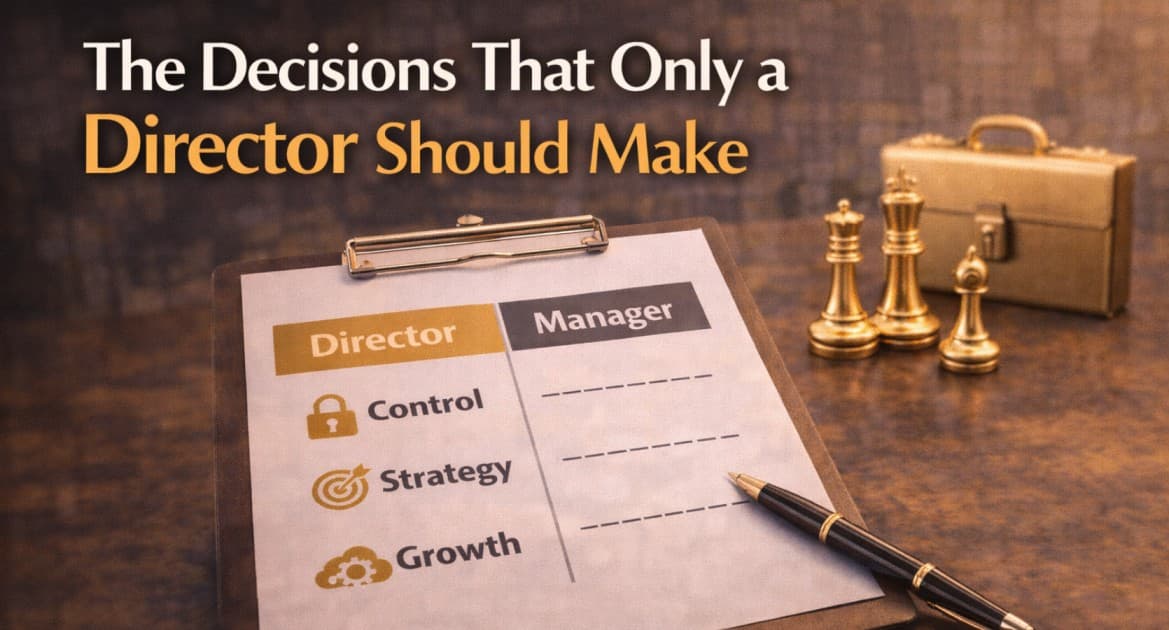
The Decisions That Only a Director Should Make
In a scaled business, confusion over who decides what creates risk, rework, and slow execution. This article defines the decisions that must stay with the director and the operating rules that prevent authority drift.
In an established business, the most expensive problems usually aren’t “lack of effort” problems. They’re authority problems. Decisions get made by whoever is loudest, closest to the issue, or holding the relationship. Then the consequences land where they always land: on the director.
If you want speed and control at scale, you need clean decision rights. Not “delegation” as a vibe. Clear boundaries that stop your organisation from making irreversible calls with director-level risk attached.
This is what separates a well-run operation from a business that looks busy but bleeds margin through rework, disputes, and unmanaged exposure.
Quick Answer
The decisions only a director should make are the ones that change the business’s risk profile, capital position, legal exposure, or strategic direction. That includes ownership and structure, major spending and financing, executive hiring and firing, signing high-liability contracts, approving the operating plan and targets, and setting governance rules. Everything else should be delegated with tight guardrails and reporting.
Why “Who Decides” Becomes a Profit and Risk Issue at Scale
In a scaled operation, unclear decision rights create three predictable failures.
Execution slows because people wait for permission or shop decisions around until they get the answer they want
Standards fall because managers optimise for local outcomes, not enterprise risk and margin
The director becomes the default escalation point, which destroys focus and creates decision fatigue
The fix is not “be more involved” or “trust people more”. It’s to define which decisions are director-only, which are executive-owned, and which are operational, then enforce the boundary through meeting cadence, reporting, and delegated authorities.
If you want a diagnostic of where your authority drift is already costing you, start with mrdirector.com.au/#established-business-assessment.
Decisions That Set or Change the Business’s Risk Profile
Directors don’t just run a business. They sit at the intersection of commercial reality and statutory responsibility. Any decision that changes risk materially must stay with the director because you’re the one exposed when it goes wrong.
Director-only risk decisions include:
Accepting or exiting a major market, channel, or customer concentration that changes dependency risk
Approving material changes to insurance program, indemnities, warranties, or limitation of liability positions
Signing off on risk acceptance when controls are known to be weak but the business proceeds anyway
Approving crisis response thresholds and authority during incidents, disputes, regulatory contact, or safety events
Setting the risk appetite in plain operational terms, not abstract statements
At scale, “risk” isn’t a policy document. It’s practical trade-offs. Margin versus contract terms. Speed versus controls. Growth versus cash. Those trade-offs require the director’s judgement because they change the company’s downside.
Capital Allocation and Cash Commitments That Can’t Be Undone
Most operational mistakes are reversible. Capital mistakes are not. Directors must own any decision that commits the business to a cash position it can’t easily unwind.
Director-only capital decisions include:
Approving annual budgets that include headcount assumptions, margin targets, and cash timing
Greenlighting major capital expenditure, systems implementations, fit-outs, fleet, or long-lead inventory bets
Authorising new debt, refinancing, security, guarantees, or changes to banking covenants
Setting dividend policy and shareholder distributions in line with solvency and working capital needs
Approving credit policy changes that materially alter debtor days or bad debt exposure
If a decision can create a solvency event, it’s director territory. Not because managers aren’t capable, but because managers often don’t carry full-context visibility of financing terms, group exposures, tax timing, and contingent liabilities.
A simple operating rule: if the downside requires a board paper, it requires a director decision. If you don’t have board papers, that’s a governance gap, not an excuse.
Ownership, Structure, and Tax Positions That Create Long-Tail Exposure
Structure decisions don’t show up on the weekly scoreboard, but they compound for years and become catastrophic when there’s a dispute, audit, sale, or insolvency scenario.
Director-only structure decisions include:
Changes to entity structure, intercompany arrangements, trusts, and shareholder agreements
Equity issuance, buybacks, option plans, and any dilution or preference rights
Director loans, related-party transactions, and distributions that could be challenged later
Approving material tax positions where the business is relying on an interpretation with audit risk
M&A decisions: acquisitions, earn-outs, vendor finance, and integration commitments
A common failure at scale is letting “the accountant” or “the lawyer” drive structure by default. Advisors advise. Directors decide. You are the one who owns the commercial intent and bears the governance consequences.
If you are a single director, these choices can become dangerously informal because there’s no internal friction. That’s exactly why you need deliberate process. Use mrdirector.com.au/#single-director-business-assessment to identify where you’ve normalised director-level risk as “just how we do it”.
Hiring, Firing, and Structuring the Executive Layer
In an established business, the biggest lever is not tactics. It’s the quality and shape of your leadership layer. Directors must own executive decisions because they set the standard, culture of accountability, and decision quality across the whole organisation.
Director-only people decisions include:
Appointing and terminating the CEO, GM, COO, CFO, and any role that controls money, risk, or delivery
Approving the executive org structure, spans of control, and role charters
Setting executive compensation frameworks, incentives, and non-compete or restraint positions
Deciding when a leader is no longer fit for role, even if they are liked, loyal, or “trying hard”
Approving succession plans for key roles and single points of failure
A director cannot delegate the formation of the executive team and then complain about execution. If you want reliable outcomes, you must own the appointments, the scorecard, and the consequences.
Approving the Operating Plan, Targets, and Non-Negotiable Standards
Many businesses run on implicit targets: “grow”, “improve margin”, “reduce churn”. That is not a plan. At scale, ambiguity creates local optimisation and excuses.
Director-only performance decisions include:
Approving the annual operating plan with clear commercial assumptions and constraints
Setting non-negotiable standards on margin, cash conversion, and delivery quality
Deciding what the business will stop doing to protect focus and capacity
Defining what constitutes “acceptable performance” for each function
Approving the KPI architecture and reporting cadence that the business will live by
Directors should not be choosing weekly tactics. But you must set the performance contract the organisation is accountable to. If you don’t define it, managers will define it for themselves, usually in ways that protect their function rather than the enterprise.
If you need a practical operating system for targets, cadence, and accountability, use mrdirector.com.au/#download-playbook.
Contracting, Legal Commitments, and Signature Authority
A scaled business signs a lot of paper. The risk is not volume. The risk is letting commercial teams commit the company to terms they don’t understand, or that don’t match your risk appetite and insurance position.
Director-only legal and contracting decisions include:
Approving signing thresholds and delegated financial authorities
Approving any contract that includes uncapped liability, indemnities outside policy coverage, or liquidated damages
Approving major customer or supplier agreements that create dependency or lock-in
Settling disputes above a defined threshold or where precedent risk exists
Any agreement that creates personal exposure for directors through guarantees or representations
You need a hard rule here: no “exceptions” without director sign-off. Exceptions become the new baseline, and the business ends up operating on the worst terms it has ever accepted.
Governance, Cadence, and What Must Be Written Down
Directors own governance. Not as a compliance exercise, but as the control system that keeps reality visible and decisions timely.
Director-only governance decisions include:
The meeting cadence that runs the company: weekly exec, monthly performance, quarterly strategy, annual planning
What gets reported, how it gets reported, and the definitions behind the numbers
Delegations of authority, including spend approvals, contracting authority, and credit decisions
The policy set that matters: WHS, cyber, privacy, financial controls, incident reporting, conflicts
Document standards: when decisions require a paper, a risk assessment, or legal review
A business without governance doesn’t become “agile”. It becomes political. Decisions shift to relationships, not rules. That’s when director time gets consumed by arbitration instead of direction.
Culture by Enforcement: The Standards You Refuse to Negotiate
Culture in a mature business is not posters and values. It’s what the leadership team enforces when it’s inconvenient.
Director-only culture decisions include:
What behaviours are termination-level, regardless of performance
Whether the business tolerates margin leakage through discounting, scope creep, or uncontrolled change requests
Whether “hero work” is celebrated or treated as evidence of system failure
Whether internal conflict is resolved through process or through escalation to the director
The standard for truth in reporting and how consequences are applied when reporting is manipulated
If you don’t enforce standards, you don’t have standards. You have preferences. And preferences don’t survive pressure.
Delegation Without Abdication: How Directors Keep Control Without Getting Dragged In
Directors who are constantly pulled into operations usually have one of two problems.
No clear decision rights and thresholds
No reliable reporting, so they don’t trust what they’re being told
The solution is not to micromanage. It’s to design the control environment.
Practical controls that keep decisions where they belong:
Delegated authorities with explicit limits for spend, contracting, pricing, and credit
Mandatory escalation triggers: when risk, cash, timeline, or reputation crosses a threshold
A single source of truth for performance reporting, with clear metric definitions
Pre-mortems for major initiatives: what could fail, how you’ll know, and who owns mitigation
Closed-loop accountability: every decision has an owner, a due date, and a verification mechanism
A director should not be the bottleneck. But you must be the designer of the decision system.
Director Rules
These are operating rules, not theory. Adopt them and enforce them consistently.
Director decides anything that changes solvency, liability, or ownership outcomes
Director sets the annual operating plan, the scoreboard, and the enforcement consequences
Executive leaders own execution decisions inside defined authorities, with mandatory escalation triggers
No material contract, spend, or risk exception is signed without a written risk note and director approval
If it isn’t written down, it didn’t happen: decisions, delegations, and performance definitions must be documented
Director Actions This Week (Checklist)
Review your delegated authorities for spend, contracting, pricing, and credit, and update thresholds to match current scale
Define escalation triggers for cash, risk, delivery failure, and reputation events, and publish them to the exec team
Identify the top five recurring escalations hitting you and eliminate them by changing decision rights or reporting
Reconfirm your executive role charters and who owns which outcomes, including hiring authority and budget control
Audit your top ten customer and supplier contracts for liability terms, termination rights, and concentration risk
Lock a monthly performance cadence with a single reporting pack and fixed metric definitions
Write down three non-negotiable standards you will enforce this quarter and align consequences with the exec team
Choose one major initiative and run a pre-mortem with named owners for each mitigation
FAQs
1. What decisions should a director never delegate?
Anything that materially changes the company’s risk profile, capital position, legal exposure, or ownership outcomes. If the downside includes solvency pressure, uncapped liability, regulatory exposure, or shareholder dispute risk, it stays with the director.
2. How do I stop managers from escalating everything to me?
Fix the system, not the people. Set delegated authorities, define escalation triggers, and enforce a reporting cadence that gives you confidence. If managers still escalate routine calls, their role charter or capability is wrong.
3. How do I know if a decision is “material” enough to be director-only?
If it’s hard to reverse, affects cash materially, sets a precedent, or exposes the business to legal or reputational damage, treat it as material. Also treat anything outside the operating plan assumptions as director-level until proven otherwise.
4. Should directors approve all hiring decisions?
No. Directors should approve executive and control roles and the structure of the leadership layer. Hiring within established role bands and budget should be owned by executives, provided standards, budget limits, and headcount plans are enforced.
5. What governance documents are essential to keep decision rights clear?
At minimum: delegations of authority, role charters for executives, a defined reporting pack with metric definitions, and contract signing rules. Without these, decision-making becomes political and the director becomes the default risk absorber.