
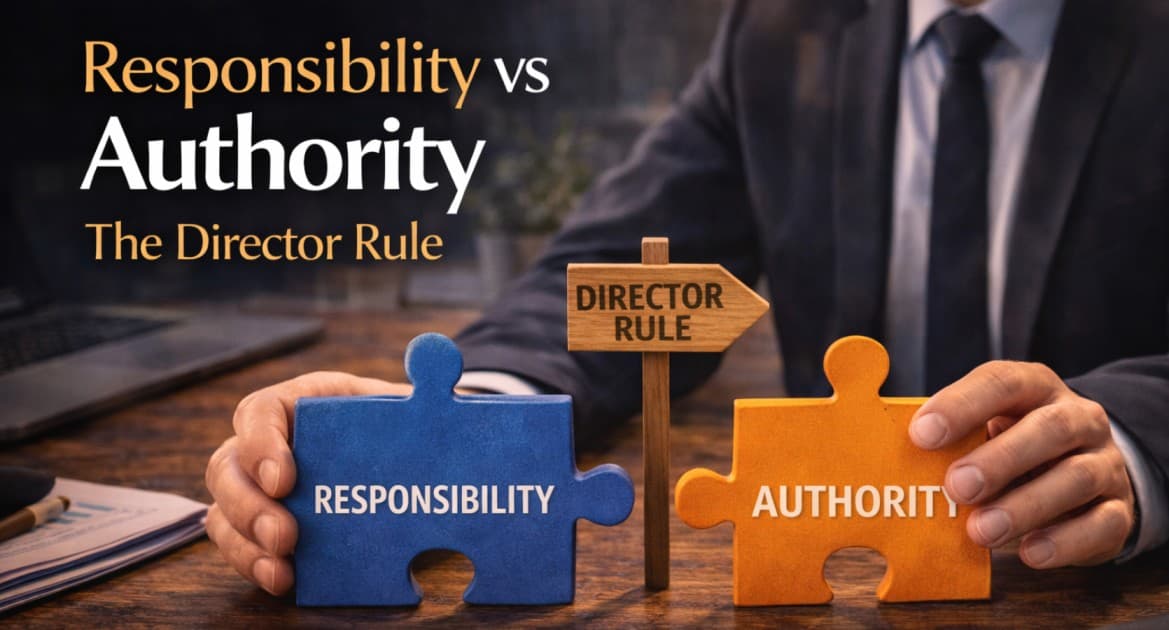
Responsibility vs Authority: The Director Rule
In profitable businesses, “accountability” without authority creates silent failure: missed numbers, compliance exposure, and team resentment. This article sets director-level rules to align decision rights with outcomes, using delegations, role charters, and operating rhythms you can implement immediately.
Responsibility vs Authority: The Director Rule
At a good amount of revenue, the business is too complex to run on goodwill and verbal agreements. You have staff, suppliers, customer expectations, and real compliance exposure. Yet many directors still let the organisation operate with a structural flaw that quietly destroys performance: people are held responsible for outcomes they don’t have authority to control.
This is not a “team culture” problem. It’s a design problem.
When responsibility and authority are misaligned, the business produces predictable outcomes: margin leakage, slow decisions, hidden risk, and a management layer that learns to deflect instead of deliver. Directors then over-function, re-enter operations, and become the bottleneck they claim to hate.
Fix the structure and the behaviour follows.
Quick Answer
Responsibility without authority is a governance failure. If a manager is accountable for a result, they must control the inputs: budget, staffing, priorities, and decision rights. Directors should implement a written Delegation of Authority, role charters tied to KPIs, and a decision cadence that forces decisions to the correct level. Otherwise, you carry the legal and financial risk without operational control.
The Revenue Consequence: You’ll Pay for Decisions You Didn’t Make
In smaller businesses, blurred roles can limp along because everyone is close to the work. At your size, misalignment becomes expensive fast.
Here’s what it looks like when you tolerate responsibility without authority:
Managers miss targets but have a ready-made excuse: “I couldn’t approve the spend,” “Sales changed the scope,” “Ops didn’t prioritise it,” “You wanted it done but wouldn’t sign off.”
Directors get dragged into daily approvals and exceptions, losing strategic time while still carrying statutory duties.
Good people burn out from being accountable without control, and you keep the wrong people because they’re “loyal” or “busy.”
Cash pressure increases because decisions are either delayed (no approvals) or made outside any delegation (random spend).
Compliance incidents occur because no one truly owns risk controls, only tasks.
If you’re the director, the end state is always the same: you own the outcome anyway. The question is whether you’ve built a system that gives the right people the authority to deliver it.
The Director Rule: Authority Must Match the Outcome
A director-level business does not run on personalities. It runs on explicit decision rights.
The Director Rule is simple:
If someone is responsible for a result, they must have authority over the resources and decisions that drive that result.
If someone does not have authority, they are not responsible. They are support.
Most businesses violate this rule constantly, then act surprised when execution is inconsistent.
This rule forces uncomfortable clarity:
Who can hire?
Who can approve pricing?
Who can stop work that breaches policy?
Who can commit the company to spend?
Who can change scope or customer promises?
Who is allowed to say “no” on behalf of the business?
If the answers aren’t written down, they don’t exist.
Where This Breaks in Real Businesses: 6 Common Failure Points
Misalignment is usually not one big mistake. It’s a set of small, habitual design failures.
Sales is responsible for revenue but cannot approve discounting or pricing exceptions, so deals stall or get escalated, or discounts are granted informally.
Ops is responsible for delivery but cannot control scheduling priorities because “the director promised the client.”
Finance is responsible for cash flow but cannot enforce credit terms because “we can’t upset customers.”
A GM is responsible for profit but cannot hire, fire, or restructure roles, so they manage around capability gaps.
A project manager is responsible for time and budget but cannot control scope because account management keeps changing requirements.
Compliance and safety are “owned” by someone junior who cannot stop unsafe work, so the system is theatre until an incident occurs.
At a decent revenue, these aren’t annoyances. They are compounding liabilities.
Diagnose It Properly: Map Outcomes to Controllable Inputs
Directors often “fix” this by writing generic role descriptions. That doesn’t work because role descriptions describe activities, not control.
Instead, map each key outcome to the inputs required to deliver it.
Outcomes you care about at director level typically include:
Monthly revenue and gross margin
Delivery performance and rework rate
Net profit and overhead control
Cash conversion, debtor days, stock turns
Customer churn, complaint volume, refunds
Safety incidents, compliance breaches, audit issues
For each outcome, force these questions:
Who has the authority to allocate budget to affect this?
Who controls headcount and capability in the area?
Who sets priorities when departments conflict?
Who can refuse work that breaks policy or margin rules?
Who can change process and enforce it?
If you can’t answer cleanly, the business is running on implied authority. That is unstable by definition.
If you need a structured review of where responsibility and authority are currently misaligned, use the appropriate diagnostic: mrdirector.com.au/#established-business-assessment or mrdirector.com.au/#single-director-business-assessment.
Build a Delegation of Authority That Actually Works
Most delegations fail because they’re either too vague (“Managers can approve reasonable expenses”) or too restrictive (everything requires the director). Either way, you stay the bottleneck.
A functional Delegation of Authority (DoA) should be a control system, not a spreadsheet people ignore. It must cover the decisions that move money, risk, and commitments.
At minimum, your DoA should define authority for:
Spend approvals by category, not just dollar limit (capex, opex, marketing, subcontractors, travel, refunds)
Contract commitments and variations
Customer terms, credit notes, and payment plans
Pricing and discount boundaries
Hiring approvals and salary bands
Termination authority and legal escalation triggers
Supplier onboarding and changes to payment terms
Write-offs and provisioning rules
Safety/compliance stop-work authority
You are not trying to decentralise “everything.” You are trying to decentralise the decisions that should not require director attention while keeping risk controls tight.
Non-negotiable operating rules for your DoA:
If it’s not in writing, it’s not approved.
Exceptions must be documented with reason and impact.
Any decision that changes risk exposure has escalation triggers, regardless of dollar value.
Authority includes the obligation to report decisions in the operating cadence.
If you keep authority centralised “to control quality,” accept the trade: you will also control speed, morale, and scalability, and you’ll absorb the operational load.
Role Charters: Replace Vague Accountability With Measurable Control
Role descriptions tell people what they do. Role charters tell people what they own.
A role charter should be one page and include:
The outcomes the role is responsible for (no more than 5)
The decisions the role is authorised to make
The budgets and resources under their control
The boundaries they cannot cross without escalation
The interfaces: who they must coordinate with, and what the handoffs are
The KPIs reviewed monthly and the evidence required
This eliminates the common game of “I’m accountable but I had no ability to change X.”
If a manager can’t influence an outcome materially, don’t assign them that outcome. It’s dishonest and it trains the organisation to lie.
If you want a tighter implementation path, adapt your role charter work alongside a formal operating system from a single source of truth, then distribute it via an internal resource such as mrdirector.com.au/#download-playbook.
Decision Cadence: Stop Letting the Loudest Voice Win
Misalignment persists because decisions are made inconsistently: sometimes in meetings, sometimes in the hallway, sometimes by whoever is present. That’s how informal authority forms.
Directors must enforce a decision cadence so the business knows:
Which decisions are made weekly
Which are made monthly
Who attends
What data is required
What happens when decisions aren’t made
Cadence also prevents escalation addiction, where managers escalate because it’s easier than owning the call.
Director-level cadence that works in operational businesses:
Weekly execution meeting focused on delivery, constraints, and next actions
Weekly commercial review focused on pipeline reality, pricing exceptions, and capacity alignment
Fortnightly cash and working capital review with enforceable actions
Monthly performance review where each leader reports against owned outcomes and shows evidence, not commentary
Quarterly risk and compliance review with documented mitigation owners and due dates
The point is not more meetings. The point is that the right decisions are made at the right level, on time, with proof.
Boundary Management: When the Director Must Override (And When You Must Not)
Some directors sabotage authority alignment by overriding managers casually, then demanding accountability later. That’s not leadership. It’s structural interference.
You need explicit override rules.
Acceptable reasons for director override:
Legal, safety, or regulatory risk
Material cash or solvency exposure
Reputation risk that cannot be reversed
A decision that breaches the DoA or role charter
Conflict between leaders that cannot be resolved within agreed interfaces
Unacceptable reasons for director override:
You prefer a different approach
You are impatient with the process
You want to keep a customer happy despite margin rules
You don’t like conflict and choose the fastest “yes”
You are anxious about letting go
If you override, you must also take the responsibility for the outcome, because you took the authority. If you keep the responsibility with the manager after overriding them, you’ve broken the system and taught everyone to avoid ownership.
Director Rules
These are the operating rules that prevent responsibility-authority drift.
i. No authority, no accountability
If a person cannot directly control the key inputs, they cannot be held responsible for the output. Reassign the accountability or expand the authority.
ii. Delegations are enforceable, not optional
Anything outside the DoA is not a “quick exception.” It is either escalated properly or declined. Repeated breaches trigger removal of authority.
iii. Decisions must have a single owner
Shared accountability is a euphemism for “no one will deliver.” Every outcome has one accountable owner with defined interfaces.
iv. Override transfers ownership
If you override a delegated decision, you own the outcome and you must document the reason and the boundary that was breached.
v. Every accountability must be evidenced monthly
No narrative reporting. Each accountable owner presents KPIs, actions taken, and decisions made under their authority. If evidence is missing, accountability is not real.
If you want these rules embedded with proper governance and execution discipline, that is the kind of work typically formalised when you mrdirector.com.au/#apply-to-become-a-client.
Director Actions This Week (Checklist)
Identify the top 5 outcomes the business must hit monthly (revenue, margin, profit, cash, delivery, compliance)
List the single accountable owner for each outcome (one name per outcome)
For each owner, write the minimum authority they require over budget, people, priorities, and policy enforcement
Draft or update your Delegation of Authority to include spend categories, contracting, pricing, hiring, write-offs, and stop-work authority
Create one-page role charters for your leadership team with outcomes, decision rights, budgets, boundaries, interfaces, and KPIs
Set escalation triggers for cash, legal/compliance, safety, and margin breaches that bypass normal delegations
Implement a weekly decision cadence with required data and documented decisions
Audit the last 30 days of “director overrides” and classify which were legitimate and which were interference
Communicate the new rules in writing and enforce them immediately, including consequences for bypassing authority
Schedule a 30-day review to confirm decisions are being made at the correct level and outcomes are improving
FAQs
1. What’s the difference between responsibility and authority in a director-run business?
Responsibility is ownership of an outcome with consequences for non-delivery. Authority is the sanctioned ability to make decisions and allocate resources that directly influence that outcome. In a director-run business, assigning responsibility without matching authority creates predictable failure and forces director intervention.
2. Why does misalignment get worse as revenue grows past $800K?
Because complexity increases faster than informal control. More staff, more suppliers, more customer commitments, and more compliance obligations create decision volume. If decisions still route through the director, execution slows and risk increases. If decisions happen informally, control breaks and the business becomes inconsistent.
3. How do I stop becoming the bottleneck without losing control?
Write and enforce a Delegation of Authority with categories, limits, and escalation triggers, then bind it to role charters and a monthly evidence-based review. You keep control through standards, reporting, and boundaries, not through being the approval point for every decision.
4. What if my managers want authority but don’t have the capability?
Then you have a resourcing problem, not a delegation problem. Either train and monitor them inside tight boundaries, or change the role. Giving authority without capability creates financial and compliance risk. Keeping responsibility without authority creates operational failure. Fix the capability gap or replace it.
5. How do I handle cross-functional conflicts where two leaders claim ownership?
Define a single accountable owner for the outcome and write the interfaces. Where conflicts are predictable, pre-decide the priority rule (cash over growth, margin over volume, safety over speed) and document it. If needed, establish a standing tie-break decision right in the DoA so disputes don’t escalate to the director by default.
mrdirector.com.au/#established-business-assessment