
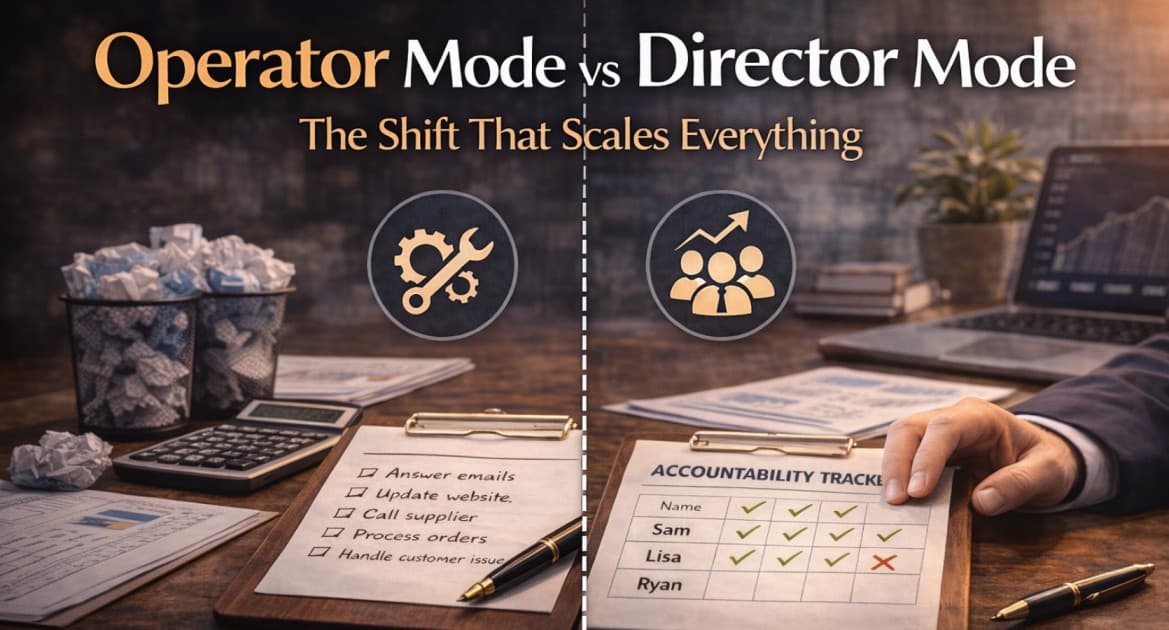
Operator Mode vs Director Mode: The Shift That Scales Everything
If you’re still running the business through yourself, growth is capped by your time and attention. This article lays out the director-mode operating system: decision rights, cadence, KPIs, accountability, and risk controls that scale a profitable business without creating chaos.
At great revenue, “working harder” stops being a strategy and becomes a liability. You can be profitable and still be structurally fragile: key-person dependency, inconsistent delivery, unmanaged cash pressure, and compliance exposure that sits quietly until it doesn’t.
Operator Mode keeps things moving. Director Mode makes sure the business can move without you pushing every wheel. The shift is not philosophical. It’s structural: who decides, what gets measured, how priorities are set, and how risk is controlled.
If you’re still the routing engine for every decision, every customer escalation, every hire, every approval, and every “quick question,” you don’t have a scalable business. You have a high-performing job with overheads.
Quick Answer
Operator Mode is doing the work and solving today’s problems. Director Mode is designing and enforcing the systems that prevent those problems and scale delivery through other people. The shift requires decision rights, an execution cadence, non-negotiable KPIs, and a governance rhythm. If you don’t make it, growth increases complexity faster than capability and profitability gets eaten by rework, churn, and cash surprises.
The Real Difference: Output vs System
Operator Mode is judged by visible output: tasks completed, fires put out, customers saved, invoices sent, staff supported. It feels productive because it is productive, in the narrow sense.
Director Mode is judged by whether the business produces outcomes reliably without your constant intervention. That requires repeatable systems and clear control points.
In a profitable business, the cost of staying in Operator Mode is not just your time. It’s:
Decisions made too late because they depend on you
Staff waiting for approvals, then improvising
Inconsistent delivery because standards live in your head
Margin leakage via rework, discounts, and priority thrash
Risk accumulating through undocumented processes, unclear authority, and weak controls
If you’re thinking “it’s fine because we’re profitable,” you’re describing the present, not the risk profile. Profitability can mask structural weakness for years. Then one key person leaves, one compliance issue lands, one major customer disputes, one cash cycle turns, and the business shows you what it actually is.
The Trap: Profit Covers Inefficiency Until It Doesn’t
At lower revenue, you can brute-force outcomes. At $800K+ with staff and operational complexity, brute force becomes an operating model. That’s the trap.
Typical symptoms:
You are the escalation point for delivery, customer issues, and staffing
You approve spend, discounts, hires, and priorities by default
Meetings exist, but decisions are vague and actions are optional
“We should” discussions repeat weekly with no closure
There is no single set of numbers everyone trusts
Cash is managed by anxiety, not forecast and rules
Compliance is reactive, handled when the accountant or solicitor flags it
Staying here doesn’t just slow growth. It makes growth expensive. Complexity rises, error rate rises, your attention fragments, and performance becomes volatile. In volatile businesses, staff churn increases and A-players avoid stepping up because the rules are unclear and accountability is inconsistent.
Operator Mode Creates a Founder Bottleneck (Even If You’re Not the Founder)
Whether you’re the founder, a working director, or a hands-on owner, the bottleneck behaves the same.
You become the “router”:
Every ambiguous decision defaults to you
Every exception requires your override
Every relationship depends on you to maintain trust
Every plan changes when your attention changes
This forces two outcomes, both bad:
People stop deciding and wait for you
People decide without authority, and you clean up the mess
Director Mode removes you as router by creating explicit decision rights, standards, and a cadence that makes execution predictable.
If you don’t do this, you will keep hiring “more hands” to compensate, and headcount will rise faster than capacity. Your P&L will show it through wage creep, inefficiency, and margin erosion.
The Hidden Costs: Cash, Risk, and Customer Trust
Operator Mode tends to optimise for immediate relief. Director Mode optimises for resilience.
Where it shows up:
Cash: late invoicing, weak collections, uncontrolled spend, no forward view
Risk: unclear authority limits, poor contract discipline, no audit trail
Customer trust: inconsistency, missed handoffs, and “we’ll fix it” culture
At decent revenue, these costs become meaningful:
One bad month of cash can force bad decisions: discounting, underinvesting, rushed hiring, or delayed compliance
One unmanaged compliance issue can become director-level exposure, not just a business issue
One operational failure can cost a top account, damage reputation, and create staff burnout
If you want a diagnostic on where the business is structurally exposed, use mrdirector.com.au/#established-business-assessment. If you’re a single working director carrying too much operational load, start with mrdirector.com.au/#single-director-business-assessment.
The Director Operating System: Cadence, KPIs, and Decision Rights
Director Mode is not “less work.” It’s different work, with non-negotiable rhythms.
A director operating system has three pillars:
Cadence: when decisions get made and reviewed
KPIs: what numbers define performance and trigger intervention
Decision rights: who can decide what, within which limits
When these are missing, the business becomes a collection of individual workflows and personal preferences. When they are present, the business behaves like a machine: predictable inputs, measurable throughput, defined controls.
A practical cadence for a profitable SME:
Weekly: performance review against KPIs, blockers removed, priorities locked
Monthly: financial review, cash forecast, capacity planning, key risks
Quarterly: strategy choices, pricing and margin review, org structure adjustments
Annually: budgets, targets, risk register refresh, major initiatives
The point is not meetings. The point is closing loops and enforcing decisions.
Director Mode Starts With Three Decisions You Must Stop Making
Most directors stay trapped because they keep making decisions that should be made elsewhere. The shift starts by withdrawing yourself from low-leverage decisions and installing rules.
Three decision categories to stop owning:
Routine approvals that can be rule-based
Operational prioritisation that should be managed by an accountable leader
Customer and staff exceptions that should be handled through standards and escalation paths
If you don’t stop, the business learns that ambiguity belongs to you. Staff will bring you problems instead of proposals. You’ll be “needed” for everything, which feels important and is operationally destructive.
The replacement is not abandonment. It’s structure:
Decision rights with limits
Standard operating rules
Mandatory reporting so you can intervene early
This is where many profitable businesses break: the director wants leverage, but refuses to let go of control without building controls.
Build a Management Layer That Actually Manages
Hiring “a manager” doesn’t solve the problem if you don’t define what management is accountable for. In Operator Mode, management becomes a title. In Director Mode, it’s a contract.
Your management layer must own:
Delivery output and quality
Team capacity and scheduling
Process adherence and improvement
Customer experience standards
Reporting cadence and issue escalation
If those accountabilities are not explicit, you get activity without ownership. If you don’t enforce ownership, you’ll be pulled back into Operator Mode to compensate.
Non-negotiables for a functioning management layer:
One person owns each function’s weekly scorecard
One person owns each cross-functional initiative
Escalations have a rule: what comes to you, when, and in what format
Managers are measured on outcomes, not effort or hours
If you need the structure and templates to set this up quickly, mrdirector.com.au/#download-playbook should be your baseline, not your “nice to have.”
Cash and Margin Control: Director Mode Runs on Rules, Not Hope
Profitable businesses still fail from cash mismanagement and margin leakage. Director Mode treats cash and margin as governed systems.
Cash rules:
Weekly cash forecast updated with real receivables and payables
Debtors process with time-based triggers and owner assignment
Spend approvals tied to budget categories and delegated limits
Clear policy on deposits, progress payments, and payment terms
Margin rules:
Pricing guardrails and discount authority limits
Job costing or delivery costing discipline, not “end of month surprises”
Defined rework categories with a weekly review of root causes
Standard scope control and variation approval process
If you cannot explain why margin moved this month in two minutes, you’re operating on lag indicators and stories. Director Mode demands leading indicators and fast correction.
Governance and Compliance: Your Exposure Increases With Scale
At $800K+ revenue, governance isn’t corporate theatre. It’s protection and decision quality.
Director Mode includes:
Documented delegations of authority
Contracting discipline and signing limits
Risk register that is reviewed, not filed away
HR basics done properly: performance management records, role clarity, fair processes
WHS and regulatory compliance with evidence, not assumptions
Consequences of ignoring this are not abstract:
Disputes become expensive because facts and approvals are unclear
Terminations become claims because documentation is weak
Tax and super errors compound and then arrive as a “surprise”
Directors end up personally exposed through negligence or poor oversight
The director’s job is not to do compliance paperwork. It’s to ensure the business has a system that produces compliance as an outcome.
Director Rules
Director Mode is enforced through rules, not preferences. Adopt these and you will feel the operational load shift within weeks.
One set of numbers: a weekly scorecard with definitions locked, owned by a single person, reviewed on the same day each week. No competing spreadsheets, no “different versions” in meetings.
Decision rights in writing: delegations of authority for spend, discounts, hiring, and customer commitments. If it’s not written, it’s not delegated.
Meetings close loops: every meeting ends with named owners and due dates, and the first agenda item next meeting is closing last week’s actions. If actions don’t close, the meeting is a cost centre.
Escalation is a system: define what must be escalated, when, and in what format. Everything else is handled by the accountable manager. No random interruptions masquerading as urgency.
Exceptions are audited: every exception to pricing, process, or scope is recorded and reviewed weekly for pattern and root cause. Exceptions are where margin and trust die.
Director Actions This Week (Checklist)
Write and publish delegations of authority for spend, discounts, hiring, and contract signing
Implement a single weekly scorecard with no more than 12 KPIs and assign a single owner to publish it
Set a fixed weekly execution meeting with an agenda that starts by closing last week’s actions
Define an escalation rule: what comes to you, what doesn’t, and how it must be presented
Choose one margin leakage point to tighten immediately: discounting, scope creep, or rework, and install an approval rule
Lock a weekly cash rhythm: forecast update, debtor review, and spend review
Identify one role you are currently “covering” and write the outcome-based accountabilities for who should own it
Audit your top three operational risks and assign an owner and review date for each
Remove yourself from one recurring operational approval by replacing it with a rule and a reporting check
FAQs
1. What’s the clearest sign I’m stuck in Operator Mode?
If the business slows down when you’re unavailable, you’re the operating system. At $800K+ revenue that means decisions, prioritisation, and standards are not embedded in roles and cadence. Profitability won’t protect you from the compounding cost of delays, rework, and key-person risk.
2. Can I be in Director Mode and still work in the business?
Yes, but your time in the business must be deliberate and bounded. Director Mode means you’re not the default router for decisions and exceptions. You can still own a function if it has clear KPIs, a backup, and it doesn’t compromise governance, cash control, or strategic cadence.
3. Do I need a COO or GM to move into Director Mode?
Not automatically. You need management accountabilities, decision rights, and reporting cadence first. Hiring a senior operator into chaos just gives chaos a higher salary. Install the operating system, then hire to scale it.
4. How do I stop staff escalating everything to me without creating risk?
You replace ad hoc escalation with defined escalation rules and decision limits. Combine delegations of authority with mandatory reporting so you still see the business through numbers and exceptions, not interruptions. The risk is not delegation; the risk is undocumented delegation with no controls.
5. What KPIs matter most when shifting to Director Mode?
Choose KPIs that control cash, delivery, and margin. Typically that means: sales pipeline coverage, conversion, gross margin, WIP or throughput, on-time delivery, rework rate, debtor days, cash balance runway, and capacity utilisation. The key is consistent definitions and weekly review, not a long dashboard.