
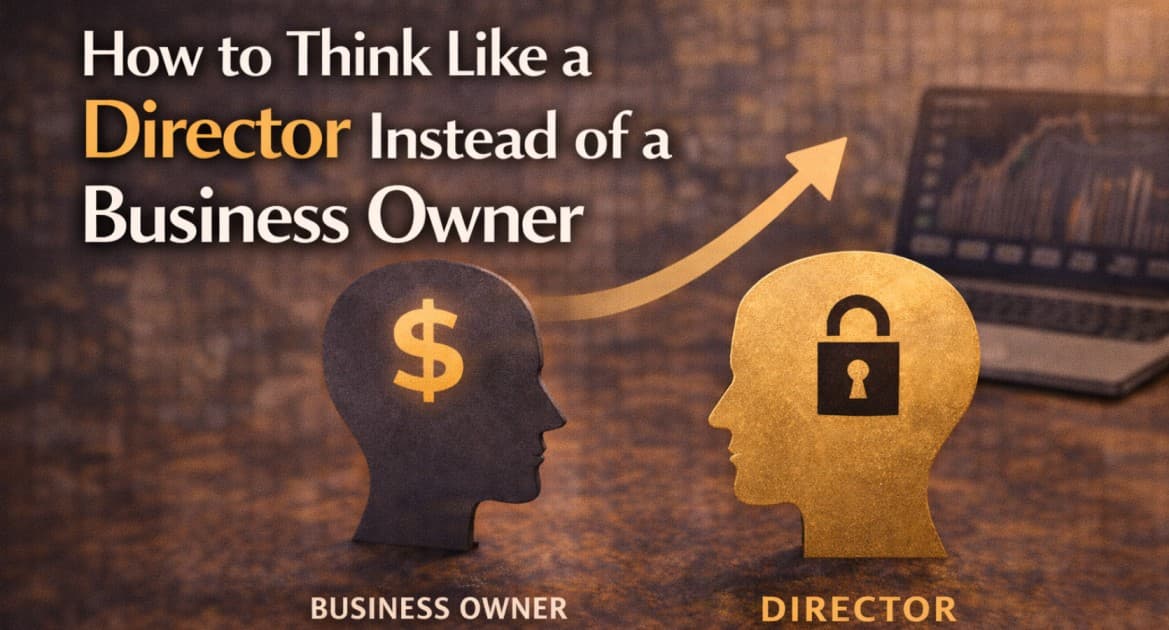
How to Think Like a Director Instead of a Business Owner
Established businesses don’t fail from lack of effort; they fail from weak control. This article outlines how directors think: governance, cash discipline, risk management, decision cadence, and accountability systems that scale.
At operational scale, “business owner” thinking becomes a liability. Owners default to effort, speed, and personal problem-solving. Directors default to control, predictability, and governance. One mode creates activity. The other creates an organisation that can withstand pressure, scrutiny, and change without relying on you.
If you’re carrying real payroll, supplier exposure, customer concentration risk, and compliance obligations, thinking like an owner is not enough. You need director-grade decision rules, financial guardrails, and an operating cadence that prevents drift. Otherwise, you’ll keep paying for the same problems: margin leakage, recurring cash strain, key-person dependency, and preventable legal exposure.
This is not about stepping back to “work on the business” in a vague way. It’s about adopting the director stance: define the rules, demand evidence, govern the risks, and build management control.
Quick Answer
To think like a director instead of a business owner, shift from doing and rescuing to governing and controlling. Directors set operating rules, enforce cash discipline, require reliable reporting, manage legal and commercial risk, and run a decision cadence that prevents drift. The goal is an organisation that performs without heroics and remains defensible under scrutiny.
Owner Mode vs Director Mode: The Shift That Actually Matters
Owner mode is personal accountability: you feel everything, fix everything, and carry the consequences. That can build a business. It does not reliably scale one.
Director mode is organisational accountability: you design the environment where performance is predictable and failures are contained. You don’t remove accountability. You redistribute it through structure.
Common signs you’re stuck in owner mode at scale:
You’re the escalation point for most decisions that matter
Financials arrive late or are not trusted, so decisions are made off instinct
Cash is “managed” by watching bank balances instead of forecasts and rules
Customer, supplier, or staff issues are solved case-by-case with exceptions
Compliance and contracts are handled when problems appear, not as a system
Managers report activity, not outcomes, and consequences are inconsistent
Director mode replaces all of that with a control system: governance rhythm, defined authorities, measurable standards, and early warning indicators.
Directors Optimise for Control, Not Convenience
Owners often optimize for convenience: what gets the problem off the desk fastest. Directors optimize for control: what reduces recurrence and exposure.
Control means:
Decisions are made at the right level with the right information
Exceptions are rare and recorded, not normalised
Results are reviewed against standards, not explained away
Risk is identified early and either mitigated, transferred, or priced in
Cash is treated as a governed resource, not a feeling
Convenience creates hidden debt. Control creates capacity.
If you want fewer fires, fewer late-night calls, and fewer “we didn’t see it coming” moments, you need to stop rewarding convenience. Start rewarding compliance with the operating system.
Your Job Is Governance: Outcomes, Evidence, Accountability
Directors don’t “support” the business with enthusiasm. They govern it with standards.
Governance at an established business level includes:
Clear accountability for outcomes, not tasks
A rhythm of review where reality is confronted early
Decision rights and authorities that match risk and complexity
Documentation that protects the company and you personally
Evidence-based management reporting that is timely and consistent
If you can’t answer these cleanly, you are not governing:
Who owns each critical outcome, and what does “good” look like?
What are the leading indicators that show problems before the P&L does?
What decisions can be made without you, and what must escalate?
What are the top business risks this quarter, and what is the mitigation plan?
What contractual and compliance obligations could harm the company if missed?
This is where many profitable businesses drift. They operate successfully, but they are not governed. When conditions tighten, drift becomes damage.
The Director’s Relationship With Cash: Rules, Not Hope
At scale, cash issues are rarely about revenue. They are usually about timing, discipline, and decision latency.
Director thinking treats cash as a governed asset with explicit rules:
You do not rely on a single “bank balance” view
You run a rolling cash forecast with assumptions you can interrogate
You set thresholds that trigger action before cash becomes urgent
You control working capital with policy, not ad hoc pressure
You separate profit from liquidity and manage both
If cash feels tight despite profitability, you likely have one or more of these:
Loose debtor discipline and inconsistent credit enforcement
Unpriced delivery complexity creating margin and cash drag
Inventory or WIP trapping cash without clear accountability
Capex and hiring decisions made without cash gating
Tax and super treated as “later” instead of scheduled liabilities
If you want a fast diagnostic, use mrdirector.com.au/#established-business-assessment to identify which part of the system is leaking cash and control.
Reporting That Directors Can Use: One Source of Truth, Early Enough to Act
Directors cannot govern off stories. You govern off evidence. That requires reporting that is both trusted and fast enough to change outcomes.
Director-grade reporting has three characteristics:
It is consistent: same definitions, same timing, same owners
It is decision-oriented: shows variances, drivers, and actions
It is linked: P&L, balance sheet, cash, pipeline, and capacity connect
If your management meeting is spent arguing about the numbers, you don’t have reporting. You have debate.
Minimum reporting discipline for a director-led business:
A monthly close that produces usable numbers quickly enough to matter
A small set of KPIs that tie to cash, delivery, and customer behaviour
A variance process where deviations trigger decisions, not excuses
Clear ownership of each metric and a documented action plan when off-track
This is not “more dashboards.” It’s fewer metrics with higher integrity.
Decision Rights and Delegation With Controls (Not Abdication)
Most established business owners either hold decisions too tightly or delegate too loosely. Both create risk.
Director thinking is explicit about decision rights:
What decisions can be made by role, within what limits?
What decisions require a second sign-off?
What decisions require escalation, and on what triggers?
What decisions require documented rationale?
Delegation without controls produces inconsistent outcomes and governance gaps. Tight control without delegation produces bottlenecks and director burnout.
If you are the only person who can approve pricing, credit terms, key hires, customer exceptions, or supplier commitments, you have a single point of failure.
If, on the other hand, your managers can commit the company to commercial terms without guardrails, you have uncontrolled exposure.
The fix is not personality-based. It’s structural:
Authorities matrix aligned to financial and legal risk
Standard terms and escalation triggers
A written exception process with accountability
Post-decision review for learning and compliance
For single-director companies, this matters even more because there is no internal counterweight. If that’s you, [Single Director Business Assessment] will show where your decision system is too informal for your current exposure.
Risk, Compliance, and Legal Exposure: Directors Don’t “Get Around to It”
At scale, risk is not theoretical. You can be profitable and still be non-compliant, poorly contracted, or dangerously dependent on a few key people and customers.
Director thinking treats risk as a standing agenda item, not a once-a-year exercise.
Focus areas that routinely cause pain in established businesses:
Employment compliance and documentation that doesn’t match reality
Contractor arrangements that won’t survive scrutiny
Customer contracts with vague scope, weak variation control, and poor payment terms
Insurance that doesn’t match operational risk and contractual commitments
WHS and safety practices that exist informally but not defensibly
Data and privacy obligations ignored until an incident forces attention
The consequence is not just fines or legal costs. It’s loss of negotiating position, operational disruption, and in serious cases, personal director exposure.
If you want a structured way to lift governance without adding bureaucracy, use mrdirector.com.au/#download-playbook as the starting point for implementing director-level controls.
Operating Cadence: The Director’s Calendar Is a Control System
If you “don’t have time” for governance, your business is already telling you the truth: the business is running you.
Directors run an operating cadence that makes performance predictable:
Weekly: operational pulse and constraint management
Monthly: financial performance, cash outlook, and risk review
Quarterly: priorities, capability gaps, and strategic trade-offs
Annually: budget, capital allocation, remuneration structure, and major risk reset
The point is not meetings. The point is forcing decisions early, before issues become expensive.
A strong cadence has two non-negotiables:
Pre-reading with standard formats and clear ownership
Decisions and actions logged, with follow-up and consequences
If actions are not tracked and closed, your cadence is theatre.
Talent and Accountability: Directors Build a Management System, Not a Dependency
Owner mode often builds loyalty to the owner. Director mode builds accountability to the role and the standard.
At scale, your business needs:
Role clarity that separates “busy” from “responsible”
Performance measures that are within the role’s control
Consequences that are consistent and documented
Succession and coverage for critical roles
If your best people are overloaded because others are tolerated, you are making a director-level mistake. You are choosing short-term comfort over long-term stability.
Director thinking requires you to confront structural underperformance:
Roles that were never properly defined but were filled anyway
Managers who manage activity but cannot manage outcomes
Incentives that reward revenue but ignore margin, cash, and risk
Informal “exceptions” that override policy and create chaos
Accountability is not a motivational speech. It is clarity plus enforcement.
Director Rules
These rules are practical. They are the operating standards that shift you from owner mode to director mode without adding unnecessary weight.
1. Run the business on a defined cadence, not on emergencies
Weekly pulse, monthly numbers, quarterly priorities. Decisions happen on schedule, not when pressure forces them.
2. No major decision without a cash and risk view
Hiring, pricing changes, large commitments, customer exceptions, and capex must pass cash impact and risk checks before approval.
3. One source of truth for performance
If numbers are late or disputed, fix the close and definitions before you debate performance. No governance without reliable reporting.
4. Delegate with explicit authorities and an exception process
Decision rights must be written, limits must be clear, and exceptions must be logged and reviewed. “Just do it” is not a control system.
5. Treat compliance, contracts, and safety as standing controls
If it can harm the company, it must be governed continuously. Waiting for a problem is not acceptable at this level.
Director Actions This Week (Checklist)
Set a fixed monthly close deadline and assign a single owner for management reporting integrity
Implement a rolling cash forecast and agree on trigger thresholds that force action
Write or update decision authorities for pricing, credit, hiring, capex, and customer exceptions
Establish a monthly risk register review with named owners and due dates for mitigations
Standardise customer terms, variation control, and approval triggers for non-standard deals
Audit payroll, super, and tax payment schedules to remove “we’ll catch up later” liabilities
Identify the top three operational constraints and assign accountable owners with measurable outcomes
Create an actions register for leadership meetings and enforce closure before new items accumulate
Review insurance, key contracts, and WHS documentation for alignment with how you actually operate
Book a structured external review if you suspect governance drift is already costing you margin and control via mrdirector.com/#apply-to-become-a-client.
FAQs
1. What’s the real difference between a director and a business owner in an established company?
A director governs the system: decision rights, controls, reporting integrity, cash discipline, and risk management. A business owner often defaults to doing and rescuing. In a complex operation, rescuing becomes the strategy, and that’s when performance and compliance start to degrade.
2. Does thinking like a director mean stepping away from operations?
No. It means operations run through standards and managers, not through your personal intervention. You can stay close to the operation, but your involvement should be through review, governance, and constraint removal, not being the escalation point for routine decisions.
3. What systems should be in place before delegation is safe?
At minimum: written decision authorities, standard commercial terms, an exception process, reliable reporting, and a review cadence that catches drift early. Without those, delegation increases risk because people will improvise and commit the company to terms you didn’t intend.
4. How do I know if my reporting is “director-grade”?
It’s director-grade when it is consistent, timely enough to change outcomes, and trusted without argument. It must link profit, cash, and operational drivers, and it must trigger decisions through variances and actions, not explanations.
5. What are the biggest risks directors ignore in profitable businesses?
Working capital drift, informal contracting and scope control, employment compliance gaps, key-person dependency, and lack of documented decision rights. These issues don’t show up until conditions tighten, a dispute occurs, or a key person leaves, and then the cost is immediate and hard to contain.