
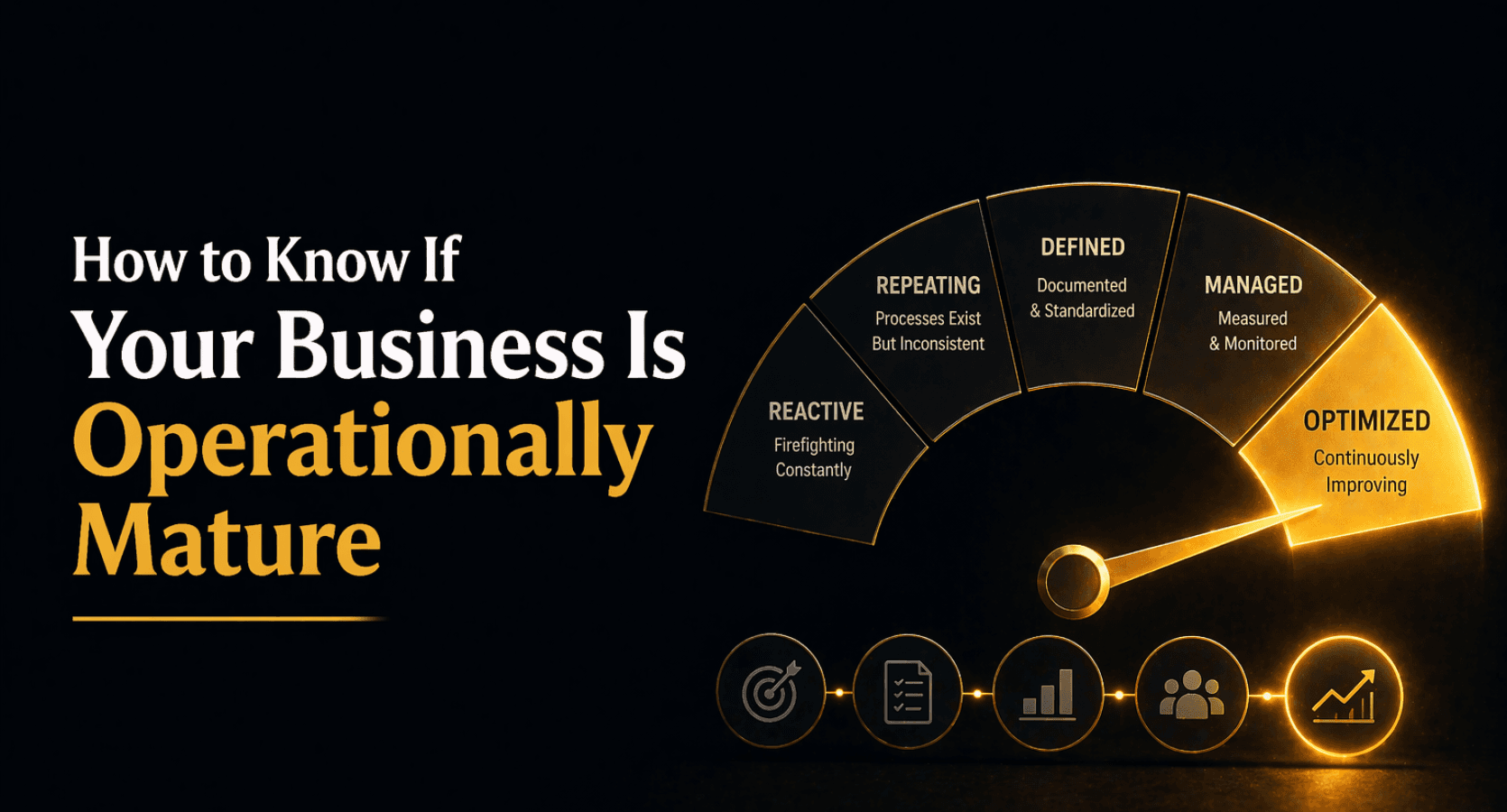
How to Know If Your Business Is Operationally Mature
Operational maturity determines whether a business can scale safely. Learn the structural signs of a mature operation and how to identify hidden risk.
Growth exposes operational weakness.
Revenue can grow while operations quietly deteriorate.
Clients increase.
Staff increases.
Complexity increases.
Without operational maturity, growth magnifies inefficiency, inconsistency, and risk.
An operationally mature business does not rely on memory, personality, or heroic effort.
It runs on structure.
Quick Answer
A business is operationally mature when:
Core processes are documented and repeatable
KPIs are tracked consistently
Accountability is role-based, not personality-based
Founder involvement is strategic, not reactive
Delivery quality is consistent across staff
If performance drops when one person is unavailable, maturity is incomplete.
Director Rule:
Operational maturity is measured by stability under pressure.
The Director Operational Maturity Framework
Operational maturity is not a feeling.
It is structural.
There are five levels of operational maturity.
Level 1: Reactive Operations
Characteristics:
Processes live in people’s heads
Constant firefighting
Inconsistent delivery
Founder solves most issues
Financial surprises are common
This stage feels busy.
It is unstable.
Director Rule:
Busyness is not maturity.
Level 2: Partial Documentation
Characteristics:
Some processes documented
Tools implemented but inconsistently used
KPIs exist but rarely reviewed
Staff still seek frequent clarification
This stage creates false confidence.
Systems exist, but discipline does not.
Risk remains high.
Level 3: Structured Control
Characteristics:
Core workflows documented
Clear onboarding process
Weekly KPI reviews
Defined meeting cadence
Financial forecasting active
Operations begin to stabilise.
Founder involvement decreases in daily execution.
This is the minimum threshold for safe scale.
Director Rule:
Documentation without review is decoration.
Level 4: Integrated Operations
Characteristics:
Cross-functional visibility
Automated reporting dashboards
Clear decision rights
Consistent margin control
Predictable delivery timelines
At this level:
Staff understand expectations
Bottlenecks are identified early
Quality control is systematic
Growth becomes controlled.
Level 5: Strategic Operational Maturity
Characteristics:
Capacity planning aligned to strategy
Scenario forecasting active
Process improvement embedded
Leadership team accountable without founder intervention
This level supports enterprise value growth.
Operational stability becomes a competitive advantage.
The 6 Core Indicators of Operational Maturity
Directors should assess across these six categories.
1. Process Clarity
Questions to assess:
Is there a documented workflow for every core service?
Is onboarding standardised?
Is there a defined handover process between roles?
If delivery depends on interpretation, maturity is low.
2. KPI Discipline
Mature operations track:
Revenue performance
Gross margin
Delivery timelines
Client satisfaction
Capacity utilisation
KPIs must be reviewed weekly.
Director Rule:
If metrics are not reviewed, they do not influence behaviour.
3. Accountability Structure
Indicators of maturity:
Role scorecards documented
Defined ownership for outcomes
Clear escalation paths
If performance issues are handled emotionally instead of structurally, accountability is weak.
4. Financial Visibility
Operational maturity requires:
90-day cash forecast
Margin reporting by service line
Cost monitoring
Financial surprises signal structural weakness.
5. Founder Dependency
Ask:
Can the founder step away for two weeks without disruption?
Do major decisions require founder approval?
Is sales dependent on one individual?
If operations stall without one person, maturity is incomplete.
Director Rule:
Operational maturity reduces personal dependency.
6. Consistency Under Pressure
Test the system:
What happens during peak demand?
What happens when a key staff member leaves?
What happens when a large client escalates an issue?
Mature operations remain stable during stress.
Immature systems collapse into reaction.
Practical Example: Service Business Under Strain
Before Operational Maturity:
Delivery timelines inconsistent
Founder approves all pricing
No structured KPI review
Cash position reviewed irregularly
Symptoms:
Staff confusion
Margin erosion
Reactive problem-solving
After Structured Systems Installed:
Core workflows documented
Weekly KPI meeting implemented
Financial forecasting active
Role accountability defined
Results:
Reduced rework
Increased margin visibility
Lower founder intervention
Improved team confidence
Stability increased without increasing effort.
Common Misconceptions About Operational Maturity
Revenue equals maturity
Revenue growth can hide structural weakness.Software equals systems
Tools do not replace discipline.Hiring creates stability
Headcount without structure increases disorder.Experience replaces documentation
Experience without documentation creates risk.Meetings equal management
Meetings without structure waste capacity.
Director Rule:
Maturity is structural, not emotional.
The Operational Maturity Audit
Directors should perform this audit quarterly.
Score each area from 1 to 5:
Revenue system clarity
Delivery workflow structure
Financial forecasting accuracy
KPI review discipline
Role accountability strength
Founder dependency level
If any score falls below 3, scaling pressure should pause.
Structural repair precedes expansion.
Weekly Operational Maturity Rhythm
To maintain maturity:
Monday
Revenue dashboard review
Capacity review
Wednesday
Workflow bottleneck identification
Quality control check
Friday
Financial position update
KPI performance review
Monthly
Process refinement
Margin analysis
Leadership performance review
Director Rule:
Operational maturity requires rhythm.
Without cadence, discipline erodes.
Director Actions This Week
Assess structural stability.
Checklist:
Map core service workflow
Identify undocumented processes
Implement weekly KPI review
Activate 90-day cash forecast
Define role scorecards
Clarify decision rights
Identify founder-dependent tasks
Schedule operational review meeting
Do not pursue aggressive growth until stability is verified.
FAQs
1. Can a business grow without being operationally mature?
Yes.
But growth will amplify instability.
2. How long does it take to reach operational maturity?
Initial structural maturity can be achieved within 90 days with disciplined implementation.
3. What is the first sign of operational immaturity?
Frequent firefighting and inconsistent delivery.
4. Does operational maturity reduce flexibility?
No.
It increases strategic flexibility by reducing chaos.
5. How does operational maturity impact valuation?
Reduced founder dependency and predictable performance increase transferability and valuation multiples.
6. Should operational maturity be reviewed regularly?
Yes.
Quarterly audits maintain structural integrity.
Operational Maturity Is a Strategic Asset
Operational maturity determines whether growth strengthens or destabilises a business.
It protects margin.
It protects reputation.
It protects leadership capacity.
Scale should be deliberate.
Not reactive.
Next Step: Measure Your Operational Strength
Most Directors overestimate operational maturity.
Complete the Mr Director Business Assessment to evaluate structural strength across Revenue, Operations, Finance, and Leadership.
Or implement the Mr Director Playbook to install operational discipline with precision.
Structure creates stability.
Stability creates scale.