
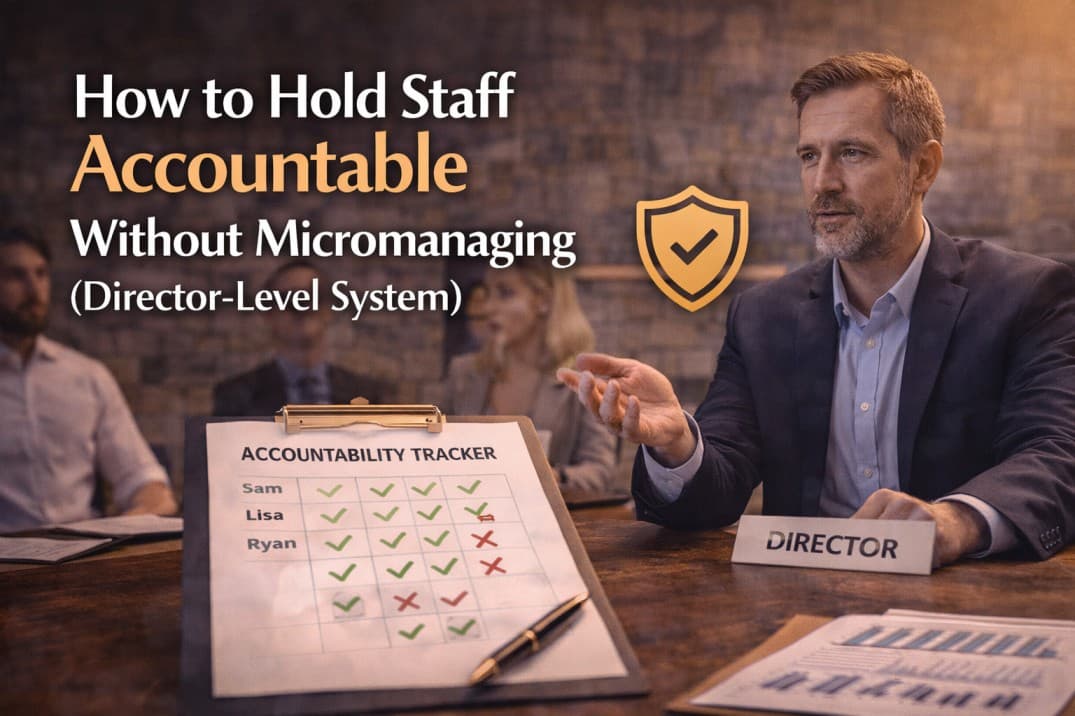
How to Hold Staff Accountable Without Micromanaging (Director-Level System)
If your business is past $800K revenue, “trust people” isn’t a control system. This article shows how directors install accountability through clear outputs, scorecards, decision rights, meeting cadence, and consequences, without daily interference or micromanagement.
At decent revenue, accountability is not a personality trait. It’s a control environment. If delivery depends on you checking every task, you don’t have a team, you have a queue.
Micromanagement is usually a symptom, not a style. It shows up when outputs aren’t defined, decision rights are unclear, and there’s no operating cadence that detects drift early. The fix is structural: install standards, measures, and consequences that run without your constant presence.
This is how directors get reliable performance from capable people while staying out of the weeds.
Quick Answer
Hold staff accountable without micromanaging by defining measurable outputs per role, tracking them on a weekly scorecard, setting decision rights, and running a short operating cadence that surfaces issues early. Pair this with written standards and clear consequences for missed commitments. If you can’t see performance in numbers and commitments, you’ll keep “checking” work manually.
Stop Confusing Activity With Accountability
Most leadership teams say they want “ownership” but manage activity because it’s visible. Activity is not accountability. Accountability is delivering agreed outputs to a defined standard, by a defined time, with predictable communication when constraints appear.
When directors manage activity, three things happen:
Your best people disengage because you’re reviewing work instead of outcomes
Your average people learn to look busy rather than hit targets
You become the system of control, which caps scale and creates key-person risk
If you want out of micromanagement, you must stop accepting activity updates as performance reporting.
Define Outputs That a Director Can Actually Enforce
Accountability starts with enforceable outputs, not vague responsibilities.
A role description that says “manage marketing” is not enforceable. An output that says “generate $X in qualified pipeline per month at Y% conversion, within $Z CAC” is enforceable.
Director-level output design rules:
Outputs must be measurable, time-bound, and comparable week to week
Each output must have a clear owner, even if others contribute
Outputs must include a standard, not just a quantity
Outputs must be linked to a business constraint: cash, capacity, compliance, quality, or delivery time
If you can’t attach a number, a deadline, and a standard, you can’t hold anyone accountable without personal oversight.
Install Scorecards That Detect Drift Before It Becomes a Crisis
If you only discover issues at month-end, you’ll micromanage mid-month to reduce your anxiety. The antidote is a scorecard that gives early warning.
Your scorecard must be small, fast, and unavoidable:
Weekly frequency, same day, same time
Fewer metrics, higher signal
Owner named next to each metric
Green or red, with a short written note when red
Trended, not one-off
Scorecards should cover the operational truth of the business:
Sales: leads, qualified pipeline, conversion, average cycle time, margin per deal
Delivery: on-time rate, rework rate, WIP ageing, utilisation, gross margin leakage
Finance: cash in bank runway, debtor days, WIP billing, forecast accuracy
People: capacity vs demand, attrition risk indicators, compliance training completion where relevant
If you don’t have a weekly instrument panel, you will compensate with daily check-ins. That’s micromanagement by default.
If you want an external view on what to measure and how to run it, use mrdirector.com.au/#established-business-assessment to identify which metrics and cadences your business is missing.
Set Decision Rights So People Don’t Wait for You
A common cause of micromanagement is not mistrust. It’s bottlenecking. If staff cannot decide, they will escalate, pause, or do “busy work” until you respond.
Decision rights need to be explicit, written, and repeated. Use three tiers:
Decisions staff can make without asking, within policy
Decisions staff can make after informing, not seeking approval
Decisions that require approval, with clear criteria and turnaround time expectations
You also need decision constraints:
Spend limits by role
Contract and discount authority
Customer promise boundaries for delivery timelines and scope
Compliance and safety non-negotiables
This removes ambiguity, speeds execution, and reduces the volume of “just checking” requests. The fastest way to eliminate micromanagement is to eliminate decision uncertainty.
Single-director businesses are especially vulnerable to decision bottlenecks. If that’s you, mrdirector.com.au/#single-director-business-assessment will surface where approval dependency is costing margin and momentum.
Replace “Follow-Up” With a Commitment System
Micromanagement often looks like follow-up. Endless “where are we at?” messages and corridor check-ins. That’s not a leadership style problem. That’s a commitment system problem.
A commitment system has three components:
A clear commitment: who will deliver what, by when, to what standard
A visible register: the commitments live somewhere everyone can see
A review cadence: commitments are checked at a consistent rhythm
Operating rules that stop the follow-up cycle:
No task is “assigned” without an owner, due date, and acceptance criteria
Commitments are reviewed in a forum, not in private chats
If a due date is at risk, the owner escalates early with options, not excuses
Missed commitments trigger a consequence, not a longer to-do list
When commitments are real, you don’t need to chase. The system does.
If you need a template set for commitments, cadences, and scorecards that matches established businesses, use mrdirector.com.au/#download-playbook.
Use Cadence, Not Presence, to Drive Performance
Your job is to design cadence that creates performance pressure without surveillance.
A strong operating rhythm for a profitable business typically includes:
Weekly leadership scorecard review focused on variances, not storytelling
Weekly delivery and capacity review to prevent margin bleed and late work
Weekly sales pipeline review based on stage definitions and conversion math
Monthly financial review that reconciles forecast vs actual and updates cash controls
Quarterly planning reset with clear priorities and kill lists
Key discipline: meetings are not for status updates. They are for decisions, removals of constraints, and commitments.
If your meetings are updates, people will hide behind words. If your meetings are decisions, people bring facts.
This is also where directors stop micromanaging by refusing to “help” in the moment. Your role in cadence is to force clarity, not to do the work.
Tie Accountability to Standards, Not Your Preferences
Micromanagement thrives when “good” is subjective. Staff don’t know what right looks like, so they send drafts, ask for reassurance, and wait for your opinion.
Standards need to be written and operational:
Definition of done for recurring deliverables
Quality thresholds and compliance requirements
Turnaround times and service levels
Brand and customer communication standards
Escalation triggers and incident reporting requirements
Standards must also be accessible at the point of work, not buried in a policy folder.
When standards are clear, managers can coach against a document, not against you. That’s how you scale consistency without becoming the reviewer-in-chief.
Consequences: If Nothing Happens When Targets Are Missed, Targets Are Optional
Accountability without consequences is theatre.
At decent revenue with staff and compliance exposure, you cannot allow a culture where missed commitments are tolerated and re-negotiated indefinitely. That’s how margin disappears and risk accumulates.
Consequences should be predictable and tiered:
First miss: root cause analysis, standard reset, and a short-term corrective plan owned by the person
Repeated miss: removal of scope, tighter controls, and formal performance management
Persistent miss: role change or exit, because the business cannot carry unreliability
Consequences also apply upward. If you keep taking work back, you train staff that you’re the safety net. Then you’ll micromanage because you’re carrying the risk.
Hold the line: commitments matter, standards matter, and performance has outcomes.
Director Rules
These rules are the minimum effective system for accountability without micromanaging. They are not optional once you have staff, customers, and real cash exposure.
1. Rule: Outputs over tasks
Every role has measurable weekly outputs and monthly outcomes. No one is accountable for “helping” or “supporting” without a defined deliverable.
2. Rule: One owner per outcome
Cross-functional work is fine. Shared accountability is not. One name owns delivery and escalation.
3. Rule: Scorecard first, story second
Meetings start with the numbers and variances. Explanations are only useful if they produce a decision, a commitment, or a constraint removal.
4. Rule: Decision rights are written
If people need your approval, it must be for defined categories only. Everything else is delegated with boundaries.
5. Rule: Missed commitments have consequences
A miss triggers a standard response. If you tolerate misses, you’re authorising them.
Director Actions This Week (Checklist)
Confirm the top business constraints for the next 90 days: cash, capacity, compliance, quality, delivery time, or pipeline
Rewrite each leadership role into measurable outputs tied to those constraints
Build a one-page weekly scorecard with owners next to each metric
Set a fixed weekly cadence for scorecard review and commitments review
Publish decision rights for spend, customer promises, discounting, and escalation triggers
Create “definition of done” standards for the top recurring deliverables that currently bounce back to you
Implement a visible commitments register with owner, due date, and acceptance criteria
Define consequence tiers for missed commitments and apply them consistently for 30 days
FAQs
1. How do I hold a strong performer accountable without demotivating them?
Set higher-precision outputs and give them broader decision rights, not more oversight. Strong performers want autonomy with clear standards. Use scorecards and commitments to measure outcomes, and only intervene when variances appear or standards are breached.
2. What if staff say KPIs feel like micromanagement?
KPIs are micromanagement only when they measure activity instead of outcomes. Track results that matter to the business constraint and give staff control over how they achieve them within written boundaries. The alternative is subjective management, which is worse.
3. How do I stop being the approval bottleneck without losing control?
Write decision rights with spend limits, promise boundaries, and escalation triggers. Control comes from constraints and reporting, not from approving everything. If you can’t tolerate delegation, tighten policy and reporting, not your grip on day-to-day decisions.
4. What if a manager keeps missing commitments but has good reasons?
“Good reasons” don’t protect margin, customers, or compliance. Treat reasons as inputs to root cause, then change the system: capacity, training, standards, or scope. If misses continue after fixes, it’s a role fit problem and requires formal consequences.
5. How often should we review accountability metrics?
Weekly for operational metrics and commitments, monthly for financial reconciliations and forecast accuracy, quarterly for role design and priorities. If you review less frequently than weekly, you’ll drift into ad hoc follow-ups, which becomes micromanagement.