
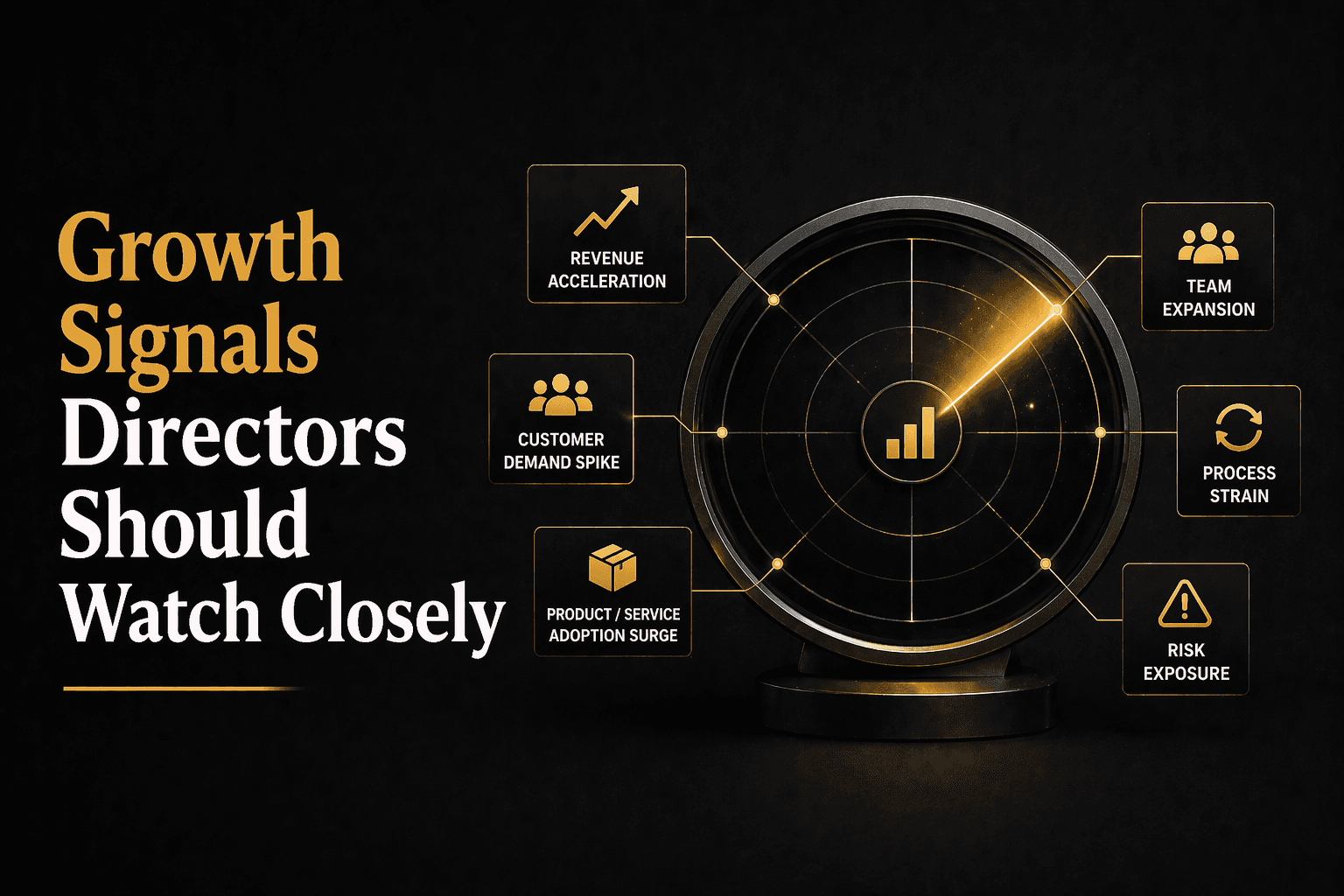
Growth Signals Directors Should Watch Closely
Growth creates subtle signals long before operational failure appears. Directors who recognise early indicators of structural strain can stabilise systems before expansion introduces financial, operational, or compliance risk.
Growth Signals Directors Should Watch Closely
Growth rarely fails suddenly.
Operational strain appears gradually through signals that most organisations overlook while revenue continues to increase. These signals do not look dramatic. In many cases, they appear as minor operational friction, slower decisions, or small inconsistencies in delivery.
Directors who have built businesses through effort and instinct often ignore these early indicators because the company still appears successful.
However, growth signals are rarely about performance decline. They are indicators that complexity is expanding faster than control systems.
Established businesses that collapse under growth pressure typically show warning signs long before the failure occurs.
Directors who understand these signals can stabilise the structure before expansion turns operational stress into financial or governance exposure.
Quick Answer
Growth signals directors should watch closely include decision bottlenecks, declining delivery consistency, reduced financial visibility, increasing management escalations, and rising operational complexity. These indicators show that the organisation’s systems are lagging behind its scale. Directors must treat these signals as structural warnings and strengthen governance, delegation, and reporting systems before continuing expansion.
Decision Bottlenecks Begin to Appear
One of the earliest growth signals is a slowdown in decision throughput.
As businesses expand, the number of operational decisions increases significantly. Pricing adjustments, staffing changes, supplier negotiations, and client commitments all require approvals.
If the director remains the central approval point, decision flow begins to slow.
This creates several operational symptoms:
Managers waiting for approval before acting
Projects stalling between stages
Escalations accumulating in leadership inboxes
Staff seeking clarification for routine decisions
The organisation adapts by routing everything through the director.
At that point, the business is optimising around one person’s availability rather than around clear operational authority.
Businesses experiencing this signal should review decision rights and governance structure using mrdirector.com.au/#single-director-business-assessment.
Financial Visibility Starts Lagging Behind Activity
Growth increases transaction volume.
More clients generate more invoices. More staff increase payroll commitments. More suppliers create additional payment obligations.
If financial systems do not evolve alongside operational scale, reporting begins to lag.
Directors may still receive monthly financial reports, but these reports often become retrospective summaries rather than decision tools.
Warning signals include:
Cash flow visibility limited to short timeframes
Receivables aging increasing without clear explanation
Profit reports that do not align with cash availability
Delayed invoicing or inconsistent billing cycles
When financial visibility falls behind operational activity, directors lose the ability to assess solvency accurately.
Growth without forward financial visibility increases financial risk even when profitability appears strong.
Managers Escalate More Frequently
As organisations grow, operational responsibility should shift toward the management layer.
However, when delegation structures are unclear, managers escalate issues upward rather than resolving them.
Escalation frequency becomes a useful signal.
Indicators include:
Managers bringing problems without recommendations
Directors asked to resolve client disputes that should remain within operational teams
Routine operational decisions pushed upward for confirmation
This pattern signals unclear decision rights and weak management authority.
Directors who consistently solve operational issues unintentionally reinforce the behaviour.
Managers learn that escalation is safer than decision-making.
The result is slower organisational response and increased leadership workload.
Delivery Consistency Begins to Vary
Another early growth signal is inconsistency in delivery standards.
When businesses expand rapidly, new staff join teams that previously operated through informal knowledge transfer.
Without documented operating systems, teams interpret standards differently.
This leads to variation across projects or clients.
Directors may notice:
Client feedback becoming inconsistent
Rework increasing
Managers intervening more frequently to correct errors
Experienced staff compensating for weaker team members
These signals indicate that systems have not matured alongside scale.
Operational systems must convert experience into repeatable process.
Otherwise, delivery quality becomes dependent on individual staff rather than organisational capability.
Internal Communication Becomes More Complex
As businesses grow, communication structures become more complicated.
Additional teams, locations, and responsibilities increase the number of coordination points inside the organisation.
Without structured reporting systems, communication becomes fragmented.
Warning signals include:
Staff requesting clarification on priorities
Multiple teams working on overlapping initiatives
Managers receiving inconsistent information from different departments
Communication complexity is not inherently problematic.
However, when communication replaces structured reporting, decision clarity deteriorates.
Directors must ensure that operational reporting systems remain simple, structured, and consistent.
Operational Urgency Becomes Normalised
In organisations under growth pressure, urgency can become the default operating mode.
Staff move from one deadline to another with little time for review or planning.
This environment may appear energetic, but it is unsustainable.
Signs of systemic urgency include:
Frequent last-minute decisions
Teams working extended hours to maintain delivery
Managers constantly resolving unexpected issues
Urgency is appropriate during critical incidents.
However, when urgency becomes routine, it signals that operational capacity and planning systems are insufficient.
Directors must treat constant urgency as a structural warning, not a cultural strength.
Hiring Accelerates Without Capability Planning
Growth often requires hiring additional staff.
However, hiring alone does not resolve structural pressure.
If the organisation lacks clear role definitions, documented processes, and management accountability, new hires increase coordination complexity.
Warning signals include:
New staff requiring extensive supervision
Managers struggling to integrate additional team members
Delivery delays despite increased headcount
These signals indicate that organisational systems have not matured enough to support workforce expansion.
Scaling teams requires structural clarity before headcount increases.
Compliance and Risk Exposure Expand Quietly
Regulatory obligations grow as businesses expand.
More employees introduce employment law obligations. Larger contracts increase legal exposure. Data collection introduces privacy compliance requirements.
Compliance failures rarely appear immediately.
Instead, exposure accumulates until an external trigger occurs, such as an audit, dispute, or regulatory inquiry.
Growth-related compliance signals include:
Inconsistent employment documentation
Informal contract variations
Incident reporting handled inconsistently
Data protection practices not reviewed during expansion
Directors must monitor compliance systems proactively.
Growth increases the consequences of regulatory failure.
Governance Discipline Begins to Slip
In fast-growing businesses, leadership attention often focuses on operational expansion.
Governance discipline can decline during this period.
Board meetings may become irregular. Strategic planning may occur reactively rather than systematically.
This is a dangerous signal.
Governance systems exist to maintain oversight during complexity.
Directors should ensure that governance discipline strengthens as scale increases.
If governance practices have not evolved alongside operational growth, the structural review inside mrdirector.com.au/#established-business-assessment can highlight areas requiring attention.
Director Framework
Directors should monitor the following systems continuously during growth phases.
Decision Authority Framework
Clearly define operational decision rights to prevent leadership bottlenecks.Financial Visibility System
Maintain rolling cash forecasts and forward financial reporting.Operating Cadence
Implement weekly and monthly review rhythms across performance, cash flow, and operational delivery.Documented Operating Systems
Standardise processes and quality benchmarks across teams.Risk and Compliance Oversight
Maintain active monitoring of regulatory obligations and operational risk exposure.
Directors seeking the underlying system templates can implement them using the operational structure provided in mrdirector.com.au/#download-playbook.
Director Actions This Week
Identify operational decisions currently waiting for director approval
Review forward cash visibility across the next 90 days
Audit escalation patterns across the management team
Document the most common delivery processes lacking formal
Review current hiring plans against operational capacity
Confirm compliance documentation is up to date
Implement a weekly operational performance review cadence
FAQs
What are growth signals in established businesses?
Growth signals are early indicators that operational complexity is increasing faster than organisational systems. They often appear as decision bottlenecks, financial visibility gaps, or management escalation patterns.
Why do directors miss growth signals?
Because performance metrics such as revenue and client acquisition may still appear strong. Structural issues often develop beneath positive performance indicators.
Are growth signals always negative?
No. Growth signals indicate that the organisation is expanding. However, they must be addressed early to prevent operational instability.
How can directors monitor growth signals effectively?
By implementing structured reporting systems, operating cadence, and clear delegation frameworks that surface issues consistently.
What is the most important growth signal to monitor?
Decision bottlenecks around leadership approval. When too many decisions depend on one individual, the organisation’s ability to scale becomes constrained.